John Presnell
c. 1786–1831 · Hobart, Sorell Springs and Antill Ponds, Van Diemen’s Land
MY FAMILY CONNECTION
4th great-grandfather
John and Eleanor Presnell arrived in Hobart aboard the Midas on 12 January 1821 with their children. John was a blacksmith by trade. Within two years, he was keeping the White Hart Inn at Sorell Springs, where the family made its home in the Midlands.
BORN
c. 1786
England
Arrived in Van Diemen’s Land
12 January 1821
Hobart aboard the Midas
DIED
20 May 1831
Antill Ponds, Tasmania
CHAPTER 01 · 1821–1822
From Hobart to Sorell Springs
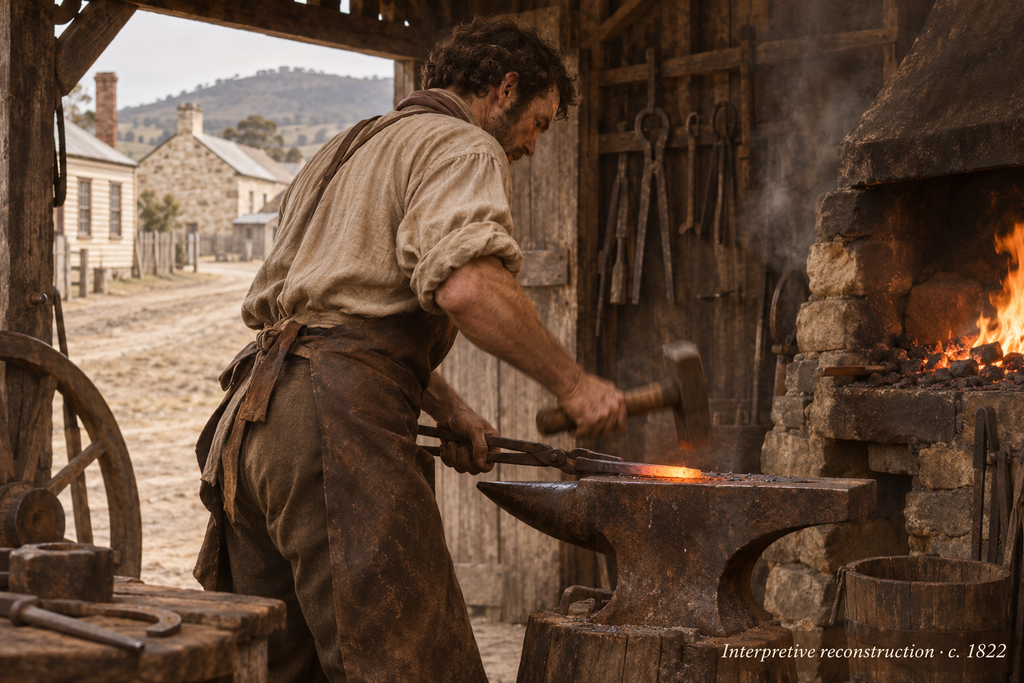
John Presnell at work as a blacksmith in Hobart Town, c. 1822. Interpretive reconstruction.
In January 1821, John Presnell arrived in Van Diemen’s Land aboard the Midas. A blacksmith by trade, he was already a married man with six children, beginning a new life far from England. Whether Eleanor and the children accompanied him remains uncertain. One possibility is that they followed later, travelling with John’s mother, Sarah Presnell, who arrived aboard the Regalia in December 1822. If so, John may have spent nearly two years establishing himself before his family joined him.
His trade would have been valuable in the growing colony, where horses, carts, farming equipment and everyday tools depended on the blacksmith’s skills. By October 1822, John had taken on another role. He was the licensee of the White Hart Inn at Sorell Springs, on the main road between Hobart and Port Dalrymple (Launceston). The inn offered John and Eleanor an opportunity to establish a home, raise their children and build a future in the Tasmanian Midlands.
CHAPTER 02 · 1822–1826
Sorell Springs — Building a Life in the Midlands

John Presnell’s February 1826 petition for an additional land grant. Tasmanian Archives, CSO1/79/1760, pp. 148–149.
By the middle of the 1820s, John Presnell had established himself at Sorell Springs, where the White Hart Inn stood beside the main road between Hobart and Launceston. The inn provided accommodation and refreshments for travellers, but John’s ambitions extended well beyond running a roadside business. He was also developing a substantial farming enterprise, raising livestock and cultivating the surrounding land.
In February 1826, John wrote to Lieutenant-Governor George Arthur seeking an additional grant of land. In his petition, he described arriving in the colony five years earlier with little more than his skills as a blacksmith. Through hard work, he had acquired approximately 300 sheep, more than 80 cattle and made considerable improvements to his property. Yet John was concerned that the land available to him was insufficient to support his growing family. He hoped that a further grant would provide greater security for Eleanor and their children. The petition offers a rare glimpse of John describing his own circumstances. He had achieved a great deal in a relatively short time, but he was still looking for opportunities to build a more secure future.
Bushrangers on the Road — A Presnell Encounter
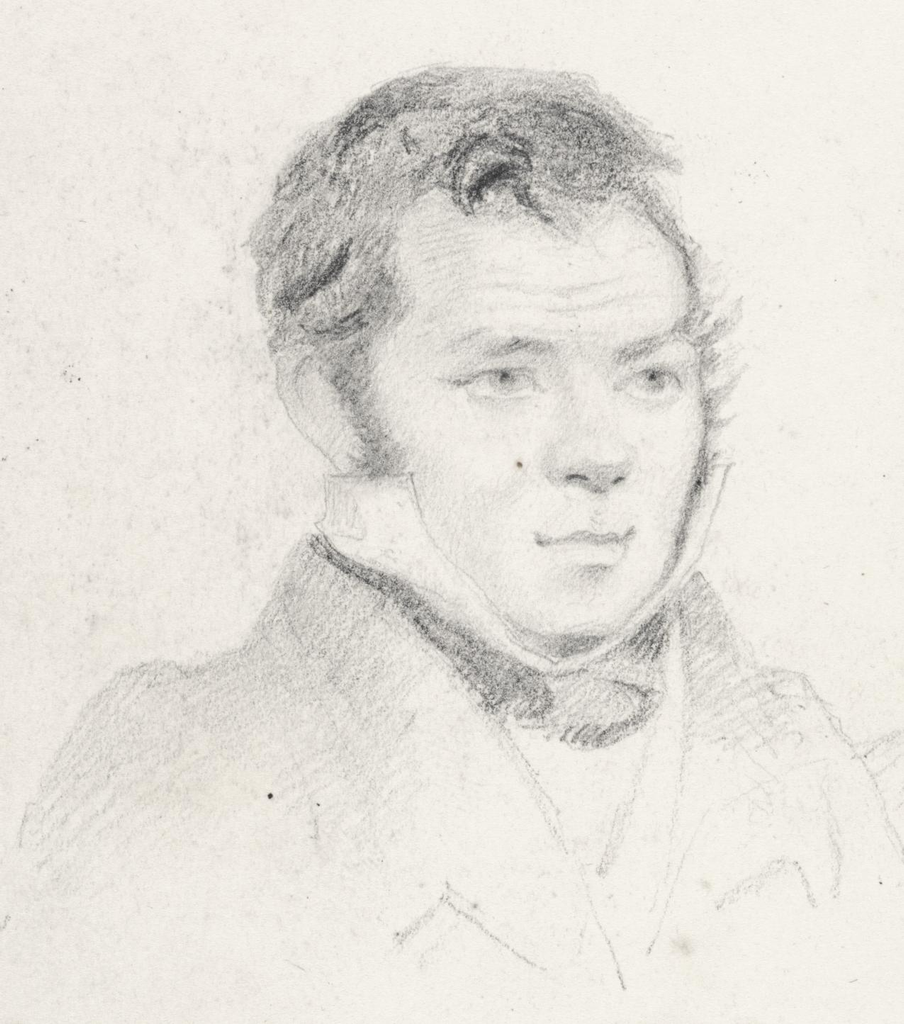
Jortrait of the notorious bushranger Matthew Brady, whose gang reportedly stopped and robbed John Presnell and a fellow traveller near Cross Marsh in the 1820s.
Life in the Midlands during the 1820s was not without danger. The road between Hobart and Launceston passed through isolated countryside where bushrangers, including the notorious Matthew Brady and James McCabe, threatened travellers.
One newspaper account describes an extraordinary encounter near Cross Marsh, less than a mile from Mr Whitfield’s property. Two bushrangers stopped Mr C. Thomson and John Presnell, threatened them with a short-distance shot into the bush, and robbed them of money and clothing.
In a remarkable exchange, McCabe swapped hats with Thomson, while the bushrangers also took a pair of pocket pistols. The newspaper described the men as being in high spirits, openly discussing their activities with their victims.
For John, who was building a home and livelihood in the Midlands, such an encounter would have been a reminder of the dangers that existed beyond the relative security of the White Hart Inn.
But bushrangers were not the only source of conflict in the Midlands. As European settlement expanded across Aboriginal lands, tensions and violence intensified. John’s next attempt to establish a home at Currajong Bottom would bring his family into another troubling episode of Tasmania’s colonial history.
CHAPTER 03 · 1826–1829
Currajong Bottom — A New Home, New Challenges
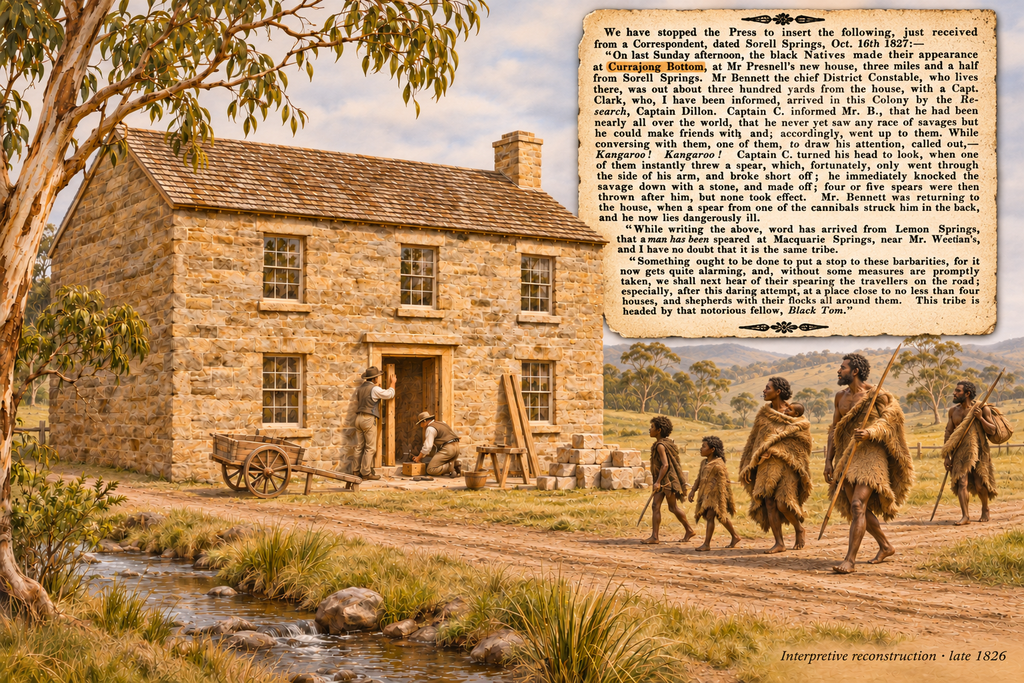
John Presnell’s new stone house at Currajong Bottom, where an October 1827 newspaper report described a violent encounter between Aboriginal Tasmanians and colonial officials. Interpretive reconstruction.
By 1826, John Presnell was looking beyond the White Hart Inn at Sorell Springs. He had built a substantial stone house at Currajong Bottom, about three and a half miles away, near the route of a proposed new road between Hobart and Launceston. The property represented another opportunity for John and Eleanor to establish a lasting home for their family. The house was associated with land jointly held by John and William Presnell, and contemporary notices referred to it as Presnell’s New Inn. Whether it ever opened to travellers remains uncertain, but John’s intentions were clearly tied to the changing road.
A Changing Road
The colonial government was improving the route through the Midlands, with road gangs cutting through difficult country and using stone gathered from nearby hills. For John, the new road presented both an opportunity and a problem. In December 1827, he petitioned Lieutenant-Governor George Arthur, explaining that changes to the road had left both his original inn at Sorell Springs and his newer house at Currajong Bottom poorly positioned to attract passing travellers. Having invested considerable effort and resources in establishing himself, John now faced the prospect of losing the passing trade on which his business depended.
Conflict at Currajong Bottom
The difficulties were not confined to roads and business. In October 1827, a newspaper correspondent reported a violent encounter involving Aboriginal Tasmanians near John’s new house at Currajong Bottom.
According to the account, District Constable Bennett and a visiting colonial officer were outside the house when they encountered a group of Aboriginal people. An attempt at conversation quickly turned violent. Spears were thrown, one striking the visiting officer’s arm, while Bennett was wounded in the back as he returned towards the house.
The report provides a glimpse of the growing conflict between European settlers and Aboriginal Tasmanians in the Midlands. As settlement expanded into Aboriginal country, disputes over land and resources contributed to increasingly violent encounters. We do not know whether John or Eleanor witnessed the incident, but it occurred close to the home they were trying to establish.
Financial Difficulties and Another Beginning
By 1829, John’s business relationship with William Presnell was under considerable pressure. In April, William advertised his share of their joint property and business interests for sale. Further newspaper notices advertised livestock and property associated with the White Hart for auction following legal proceedings. In September, the partnership between William and John was formally dissolved, with George William Robinson appointed to collect outstanding debts and settle accounts. The records do not reveal how John felt about these developments, but they mark a difficult period in his efforts to establish a secure livelihood.
Yet John was not finished. By October 1830, he was advertising another White Hart Inn, this time at Antill Ponds. After years of building, investing and adapting to the changing Midlands road, he was preparing to begin again.
CHAPTER 04 · 1830–1831
Antill Ponds — One Final Beginning
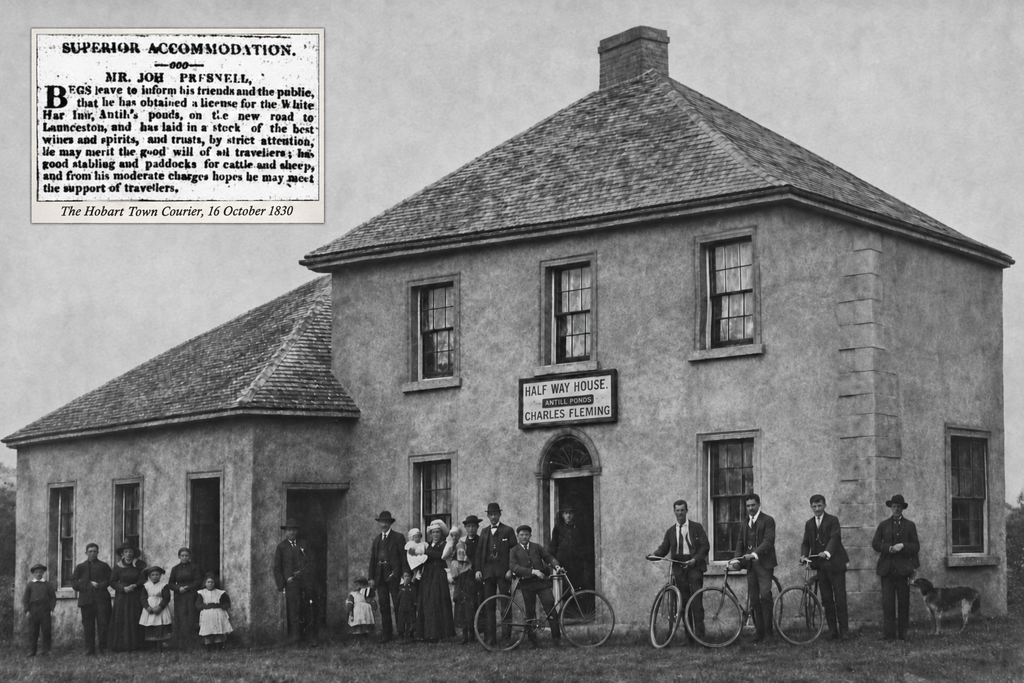
The Half Way House at Antill Ponds in later years, with John Presnell’s October 1830 advertisement announcing the opening of his new White Hart Inn.
After nearly a decade of building businesses and establishing homes in the Midlands, John Presnell was ready for another beginning. In October 1830, he announced that he had obtained a licence for a new White Hart Inn at Antill Ponds, on the road to Launceston. His advertisement promised comfortable accommodation, good wines and spirits, stabling and paddocks for travellers’ horses and livestock. It was a familiar undertaking for John, who had spent much of his time in Van Diemen’s Land combining innkeeping with farming. But this was also his third attempt to establish a lasting home and livelihood in the Midlands.
Despite the difficulties he had encountered, John had built up considerable property and livestock holdings. In March 1831, he reported holding 300 acres by grant and another 300 acres by purchase, with 105 acres cleared. His livestock included 900 sheep, 100 cattle and three horses. These were substantial achievements for a man who had arrived in the colony just ten years earlier with his skills as a blacksmith.
In March 1831, John applied for an additional grant of land from the White Hart Inn at Antill Ponds. He said the change in the road had cost him dearly, forcing him to pull down the house he had built and move it to Antill Ponds. By then he described a seven-room inn, a six-stall stable and a blacksmith’s shop. John died that May before he could appear before the Land Board. Eleanor kept the inn open and took up the application herself.
Sadly, John had little time to enjoy his latest undertaking. On 20 May 1831, he died at the White Hart Inn at Antill Ponds, aged approximately 45. His death notice recorded that he left a wife and five children. For Eleanor, John’s death meant the loss of her husband and the challenge of continuing the life they had worked to establish together. Later that year, she appeared in the licensing records in her own name, carrying on the White Hart Inn.
John’s journey through Van Diemen’s Land had ended, but the story of the White Hart — and the Presnell family’s connection to the Midlands — continued.
CHAPTER 05 · 2026
A View From My Beer — A Conversation with John Presnell
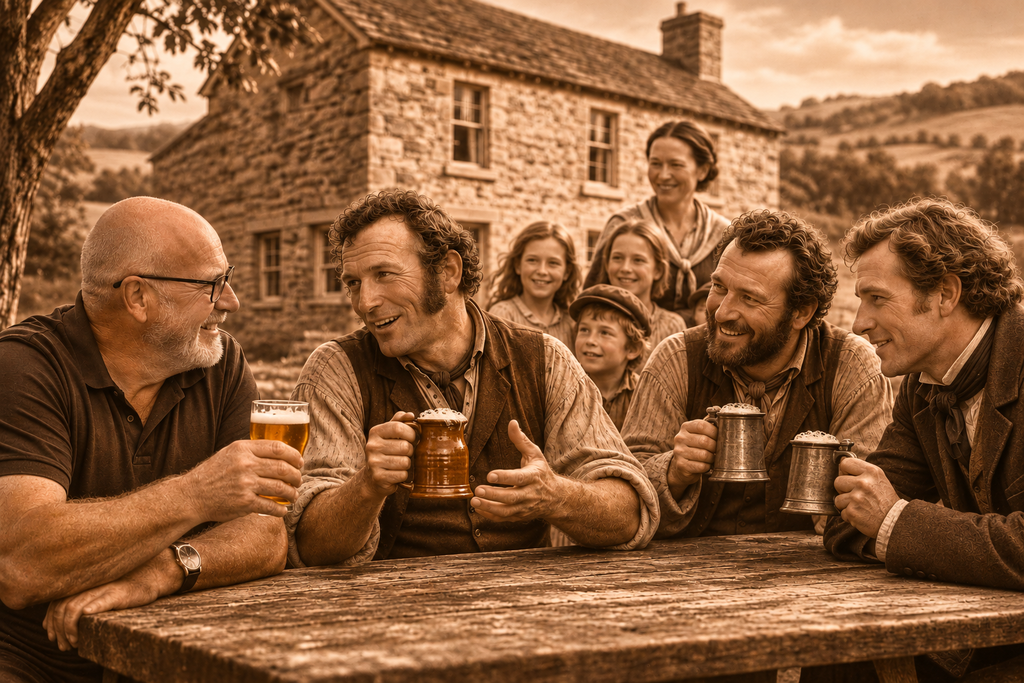
Sharing an imagined beer with my fourth great-grandfather John Presnell and his brothers William and Thomas at the White Hart Inn, Antill Ponds, c. 1830, with Eleanor and the children looking on. Interpretive reconstruction.
If I could travel back nearly two hundred years, I’d like to spend an afternoon at the White Hart Inn at Antill Ponds, sharing a beer with my fourth great-grandfather, John Presnell. I’d choose 1830, shortly after John had opened his latest inn. At around 44 years of age, he had already experienced more than his share of challenges in Van Diemen’s Land.
I’d introduce myself as his fourth great-grandson, born 130 years after his death. I wonder what he’d make of that. I’d hope Eleanor and the children might join us along with his brothers Thomas and William. After all, they had shared the uncertainties and upheavals of John’s journey.
I’d begin by asking about England.
What made you leave your homeland in 1821, John? Were you seeking opportunity, escaping difficulties, or simply hoping to provide a better future for your family?
What do you remember about bringing your family ashore in Hobart? What did you and Eleanor hope to find there?
Then I’d ask about Sorell Springs.
You arrived as a blacksmith, but within two years you were running the White Hart Inn and developing a farming enterprise. How did that opportunity come about? Did you ever imagine you’d become a publican and landowner?
I’d want to learn more about encounters with bushrangers and the types of travellers that frequented the inn.
Currajong Bottom would raise even more questions.
You built a substantial stone house and appeared ready to establish another inn. What were your plans for that property? How much did the changing road affect your ambitions?
And what happened between you and William Presnell? Was the dissolution of your partnership simply a business decision, or did it strain your family relationships?
I’d also want to understand what life was like for your family during the growing conflict between settlers and Aboriginal Tasmanians. What did you know about the people whose country you were settling? How did the violence near your new home affect you and Eleanor?
Finally, I’d ask about Antill Ponds.
After everything you’d experienced, what gave you the confidence to start again? Did you believe you’d finally found the place where your family could put down lasting roots?
Of course, sitting there in 1830, I’d know something John didn’t. His life would end the following May, leaving Eleanor to carry on the White Hart. I wonder whether I’d tell him. Perhaps instead I’d raise my glass and ask one final question.
“John, looking back over your life, what are you most proud of?”
I’d like to think his answer might have less to do with inns, roads and acres of land than with Eleanor and the family they had raised together. But that’s something only John could tell me. And it’s why, nearly two hundred years later, I’d still like to buy him a beer.
Historical Sources and Further Reading
John’s petitions are among the few records in which he speaks for himself. In his 1826 memorial, he recalled arriving aboard the Midas in January 1821 and described the buildings, livestock and other improvements he had made at Sorell Springs. Licensing notices and newspaper advertisements trace his work as an innkeeper, while a notice published after his death records Eleanor carrying on at Antill Ponds.
Colin Mallett, I’ll meet you halfway: the migration of the Presnell family to Van Diemen’s Land. An account of John and Eleanor’s migration and settlement in the Midlands, with references to their correspondence in the Tasmanian Archives. The Write Side of History
WikiTree, John Presnell (Presnell-465). A collaborative family-history profile and a starting point for tracing family relationships. WikiTree profile
The White Hart Inn. The companion story follows the inns at Sorell Springs and Antill Ponds, the changing Midlands road and the later history of the Half Way House.
John’s memorial, licensing notices and other contemporary documents are collected under Original Records.
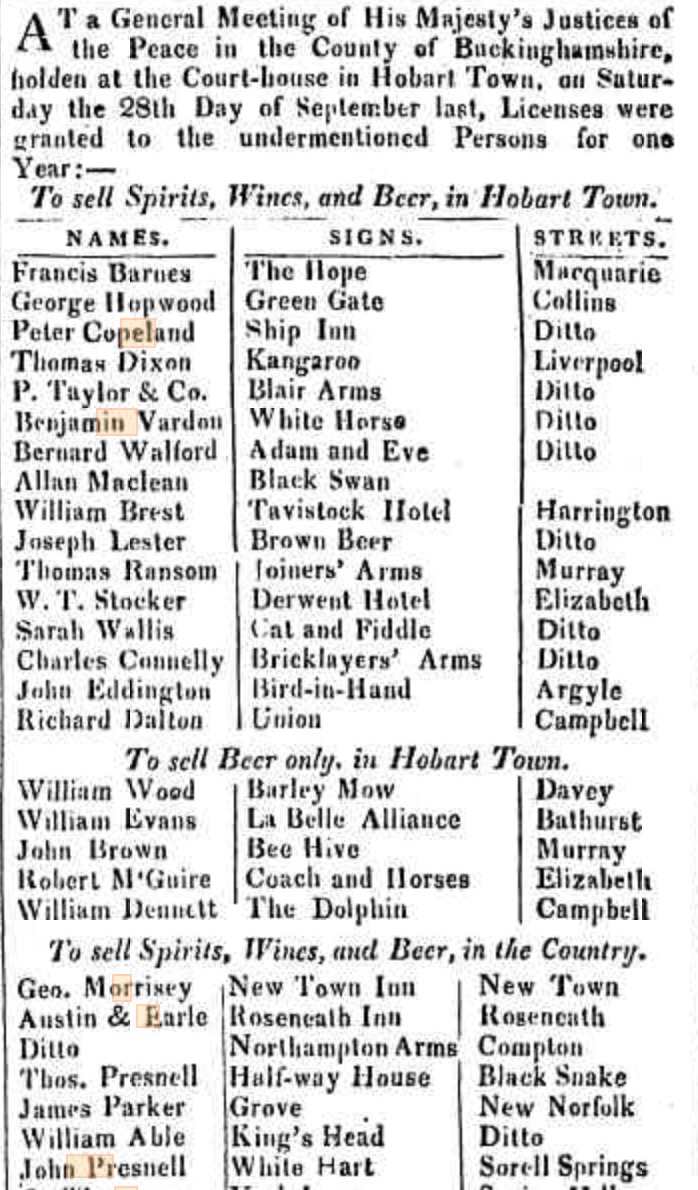
1822 — John’s first White Hart licence
The licensing notice names John Presnell as the licensee of the White Hart at Sorell Springs, on the road between Hobart and Launceston. Hobart Town Gazette and Van Diemen’s Land Advertiser, 5 October 1822

1826 — John petitions for more land
John recalls arriving aboard the Midas in January 1821. He describes what he had built up at Sorell Springs by 1826, including buildings, about 300 sheep and 80 cattle, and asks for more land to support his family. Tasmanian Archives, CSO1/79/1760, pp. 148–149, 8 February 1826.
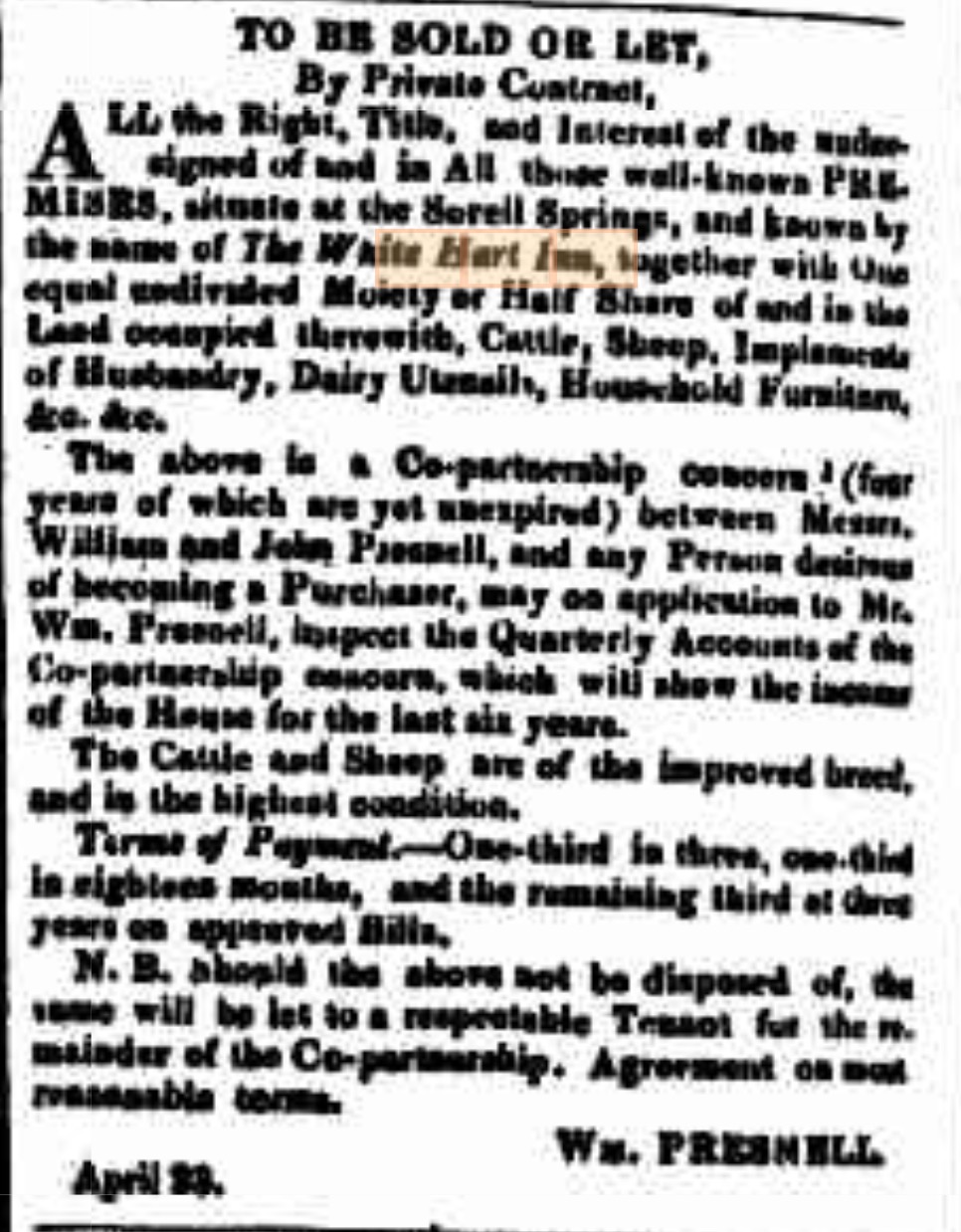
1829 — William offers his share for sale or lease
William Presnell advertises his share of the White Hart property at Sorell Springs, along with his interest in livestock and other assets. The notice shows how closely the inn and farm were tied together in his partnership with John. The Hobart Town Courier, 25 May 1829, p. 4
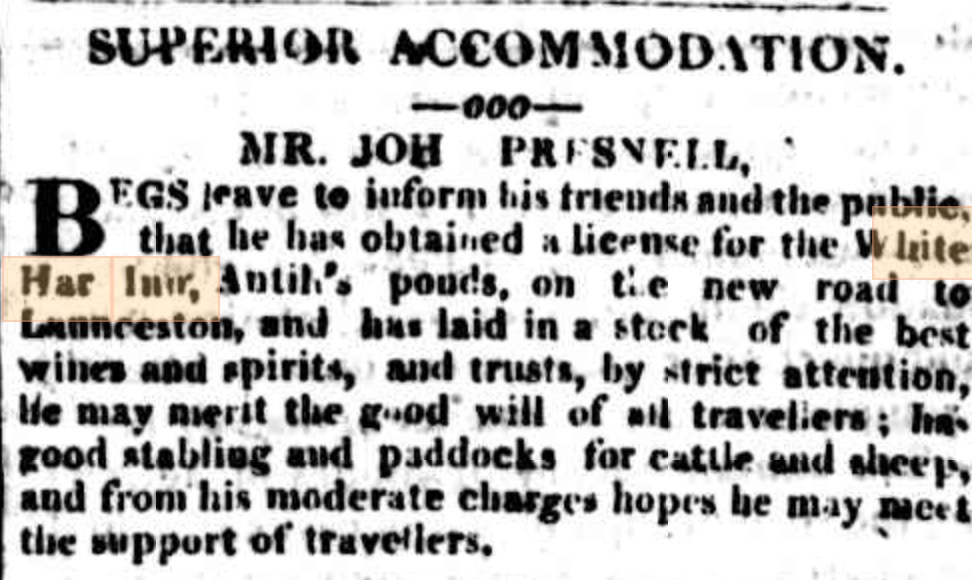
1830 — John advertises the White Hart at Antill Ponds
Under the heading “Superior Accommodation”, John announces that he has obtained a licence for the White Hart on the new road to Launceston. He offers stabling for horses and paddocks for cattle and sheep. The Hobart Town Courier, 16 October 1830.
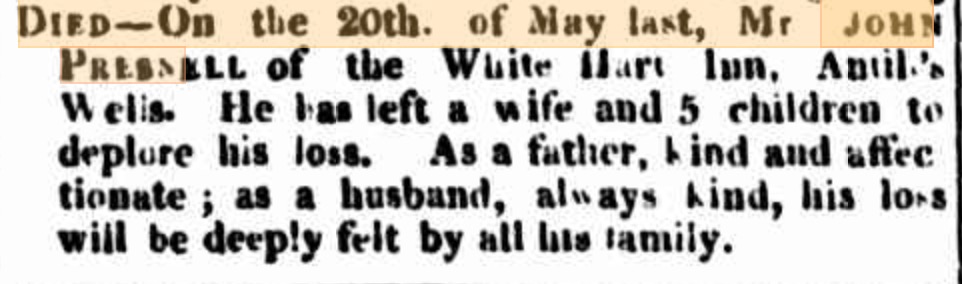
1831 — John’s death notice
The notice records John’s death on 20 May 1831, identifies him with the White Hart Inn at Antill’s Wells and says he left a wife and five children. The Hobart Town Courier, 25 June 1831, p. 2
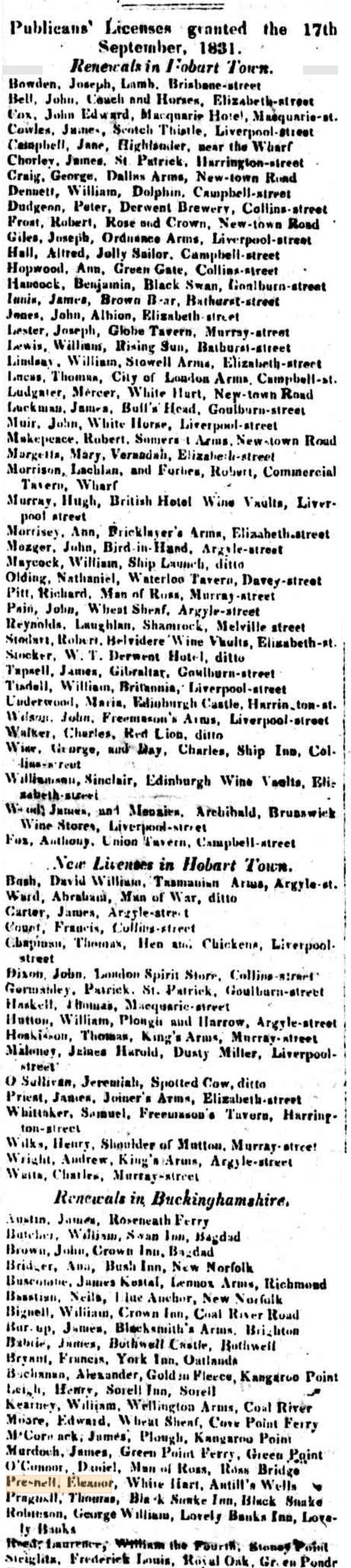
1831 — Eleanor’s licence renewal
Four months after John’s death, the published renewals list Eleanor Presnell in her own name at the White Hart, Antill’s Wells. Colonial Times, 21 September 1831, p. 4
John Presnell and Eleanor Skelton were my fourth great-grandparents. My branch of the family continues through their daughter Christiana, who married Thomas Presnell Jr at New Norfolk in 1826. Their son William Thomas Presnell carried the line into the next generation.
Parents
Sarah Presnell may have been John’s mother. The relationship remains open pending a record that directly connects them.
Spouse
John married Eleanor Skelton on 21 September 1807. After his death in May 1831, Eleanor continued at the White Hart Inn at Antill Ponds. By September, the published licence renewals listed her in her own name. Colonial Times, 21 September 1831, p. 4
Children
John’s death notice records that he left five children. Christiana is my 3rd great grandmother. The Hobart Town Courier, 25 June 1831, p. 2
|
Name |
Date of birth |
Place of birth |
Date of death |
|
Christiana Presnell |
9 Oct 1808 |
London, England |
3 Sep 1870 |
|
William Presnell* |
11 Mar 1810 |
London, England |
unknown |
|
Thomas Presnell |
27 Jan 1812 |
London, England |
bef 1831 |
|
John Presnell |
9 Jan 1814 |
London, England |
29 Jul 1888 |
|
Frederick Presnell |
12 Feb 1817 |
London, England |
1 Jul 1906 |
|
Eleanor Elizabeth Presnell |
6 Jun 1819 |
London, England |
21 Aug 1891 |
|
William Presnell |
11 Jan 1826 |
Antil Ponds, Tasmania |
8 Jul 1904 |
- William Presnell (born 1810) needs to be investigated. Most likely died as a child. Baptism record for 1826 may be the second child of same name.
Christiana’s marriage entry names Thomas Presnell senior and John Presnell senior as witnesses, bringing both branches of the family together in one record. New Norfolk marriage register, 1826, entry 968
Did Thomas travel with John on the Midas?
In his 1826 memorial, John recalled arriving aboard the Midas in January 1821. Whether Thomas Presnell Sr travelled with him remains open. The newspaper’s shipping report names only some of the passengers, and the later Regalia notice names Sarah Presnell and her family without identifying who accompanied her. Hobart Town Gazette and Southern Reporter, 13 January 1821, p. 2
Where was the stone house at Currajong Bottom?
In September 1826, John described a stone house and premises at Currajong Bottom, about three miles from Sorell Springs. His son William’s obituary later associated him with the Half-Way House and adjoining land at Rockwood. The original Bradley grant reportedly extended to Currajong Rivulet, which makes Rockwood a plausible location. The Heritage Register dates John’s acquisition of the grant to 1830, four years after the stone house notice. The exact parcel and any connection between the stone house and Presnell’s New Inn remain open. Tasmanian Heritage Register, Rockwood
Who was the “Mr J. Presnell” stopped by bushrangers?
The newspaper account identifies one of the travellers stopped near Cross Marsh as “Mr J. Presnell”. The name and location make John a possibility, but the report gives too little detail to identify him with confidence.
The two sons named William
Two sons appear in the family records under the name William. The elder William’s death date is uncertain. The younger William’s obituary gives Antill Ponds as his birthplace and appears to give January 1825 as the date. The family history gives 11 January 1826. The original baptism entry may clarify the date and where the family was living at the time.