The White Hart Inn
A Presnell Family Story
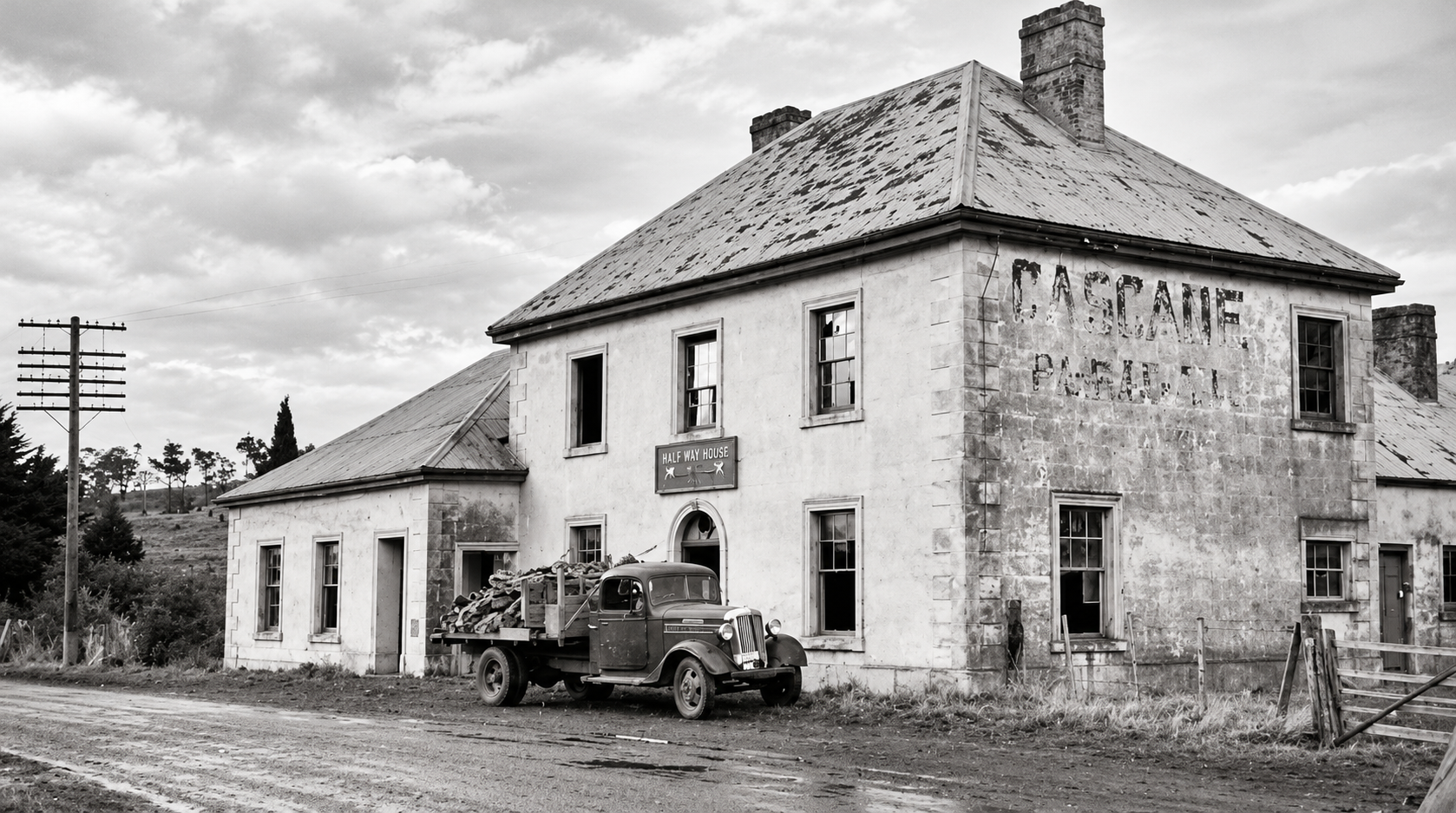
The former White Hart Inn at Antill Ponds, later known as the Half Way House. Established by John Presnell in 1830, the building was subsequently altered and rebuilt before its demolition in 1975.
The White Hart Inn played an important role in the early history of the Presnell family in Van Diemen’s Land. Beginning in 1822, the family’s involvement in roadside hospitality, farming and land development became closely connected with the changing route between Hobart and Launceston.
The story began at Sorell Springs, where John Presnell took over an existing inn established by Jonathan Kinsey. As plans emerged to improve the main road, John invested in a second establishment at Curryjong Bottom, only to discover that further changes to the proposed route threatened his investment.
By 1830, John had established the White Hart Inn at Antill Ponds, where the family continued its involvement following his death in 1831. The establishment later became widely known as the Half Way House and remained a familiar landmark for generations of travellers.
Historical newspaper reports, government correspondence, land records and surviving photographs reveal a more complicated history than previously understood. Rather than a single inn simply moving from one location to another, the evidence points to three distinct establishments or building sites associated with the Presnell family’s activities.
This is the story of those establishments, the family who developed them, and the search to identify what remains of their history in the Tasmanian Midlands today.
CHAPTER 01 · 1822–1826
The First White Hart at Sorell Springs
1822 – The Origins of the White Hart Inn
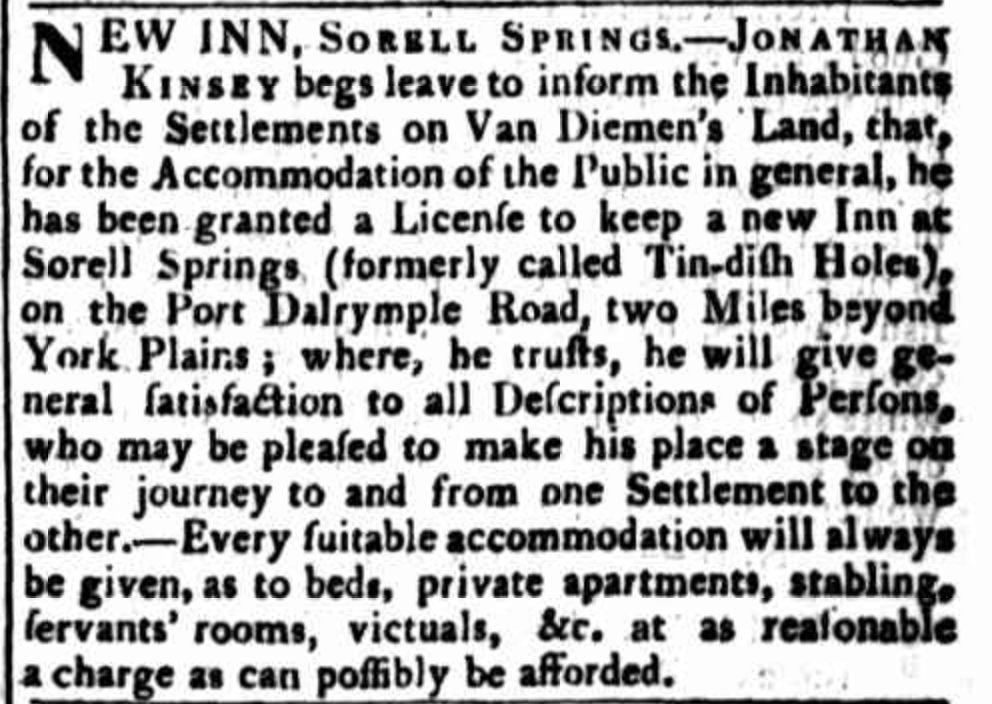
Jonathan Kinsey advertises his newly licensed inn at Sorell Springs, offering accommodation, meals and stabling for travellers. Hobart Town Gazette and Van Diemen’s Land Advertiser, 4 May 1822.
In 1822, the White Hart Inn opened at Sorell Springs, a small settlement on the original road between Hobart and Launceston. The locality, previously known as Tin Dish Holes, lay approximately two miles beyond York Plains for travellers heading north.
The first recorded licensee was Jonathan Kinsey, who advertised his new inn in May 1822. His notice promised comfortable accommodation, private apartments, meals and stabling for travellers undertaking the long journey between the colony’s principal settlements.
By September 1822, the establishment was already known as the White Hart Inn, providing an important stopping place along the colonial mail route.
1822 — The White Hart and the Colonial Mail
In 1822, the White Hart Inn at Sorell Springs was already recognised as an important landmark on the postal route between Hobart and Launceston.
A government notice establishing postage rates identified the establishment as the “Half-way House (Kinsey’s White Hart, Sorell Springs).” Letters carried by government messengers between either town and this halfway point were charged half the rate for the complete journey.
The notice demonstrates the inn’s importance beyond providing accommodation and refreshments. It served as an officially recognised reference point on the route connecting northern and southern Van Diemen’s Land.
Interestingly, the description also establishes that the name Half-way House was associated with the original White Hart at Sorell Springs decades before the later establishment at Antill Ponds became widely known by that name.
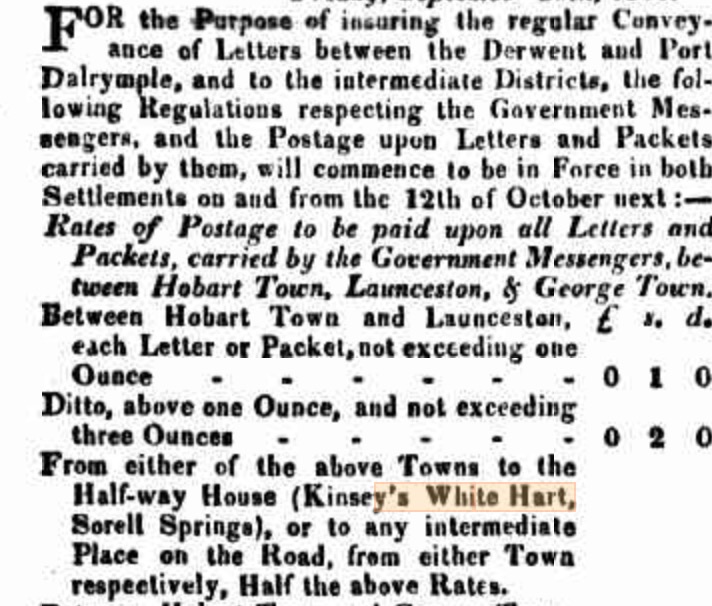
Government postal regulations identifying Kinsey’s White Hart at Sorell Springs as the Half-way House between Hobart and Launceston, 1822.
September 1822 – John Presnell takes over
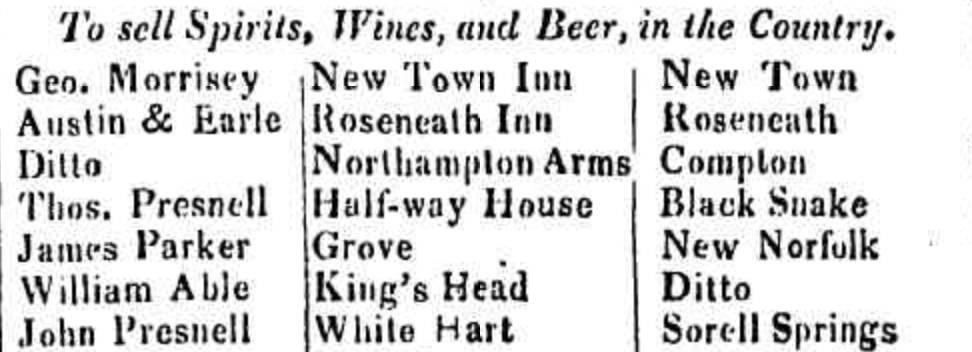
John Presnell arrived in Van Diemen’s Land aboard the Midas in January 1821. A blacksmith by trade, he initially established himself in Hobart, advertising blacksmithing and farriery services near Wellington Bridge in February 1822.
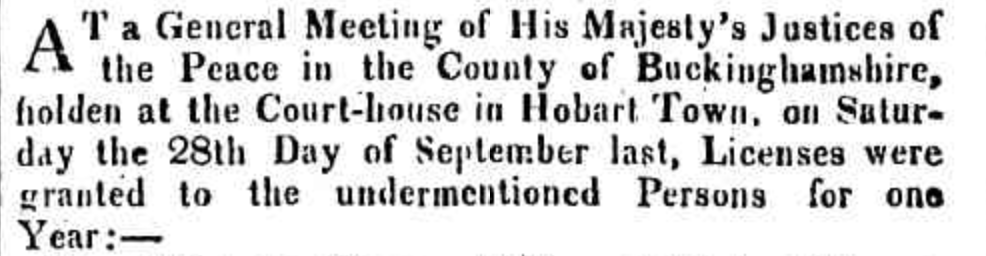
Later that year, John moved his business interests to Sorell Springs. At a licensing meeting held on 28 September 1822, he was granted a licence to operate the White Hart Inn, taking over an establishment previously associated with Jonathan Kinsey.
The licensing notice published on 5 October 1822 provides contemporary confirmation of John’s entry into the innkeeping trade.
1822–1826 — Five Years of Documented Innkeeping
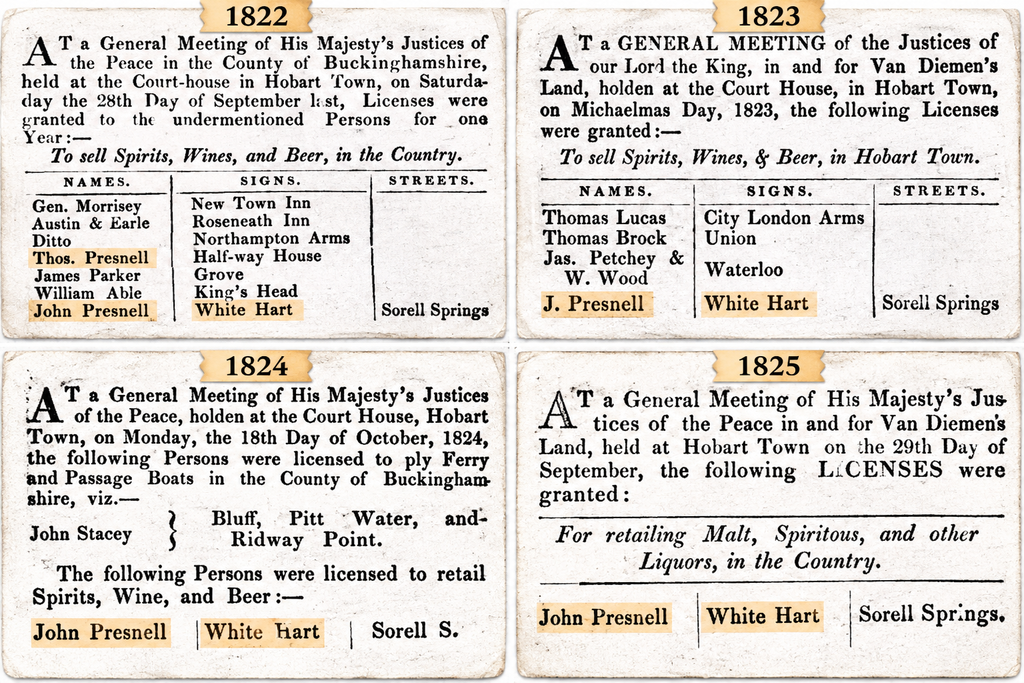
Annual licensing notices from 1822, 1823, 1824 and 1825 identifying John Presnell as licensee of the White Hart Inn at Sorell Springs.
1822–1826 — Five Years of Documented Innkeeping
John Presnell’s association with the White Hart Inn at Sorell Springs is confirmed by five consecutive annual licensing notices published between 1822 and 1826.
Each identifies John Presnell, or J. Presnell, as the licensee of the White Hart, providing contemporary evidence of the inn’s continued operation under his name.
By September 1826, John also owned a substantial stone house and 300-acre property at Curryjong Bottom, demonstrating that his investment in a second establishment was already underway while the White Hart remained licensed at Sorell Springs.
The Presnell family establishes itself
The White Hart Inn was more than a roadside stopping place. It formed part of a growing agricultural enterprise developed by John Presnell and his family at Sorell Springs.
John acquired approximately 300 acres in the district, while other Presnell family members also held land nearby. The properties provided opportunities for livestock grazing, cultivation and the development of buildings and other improvements.
In a memorial submitted to Lieutenant-Governor George Arthur on 8 February 1826, John described himself as a blacksmith and licensed victualler. He reported owning more than 300 sheep and approximately 80 cattle, evidence of the substantial farming operation he had established alongside the inn.
The memorial also recorded that John had a wife and four children, providing a valuable contemporary glimpse of the family’s circumstances.
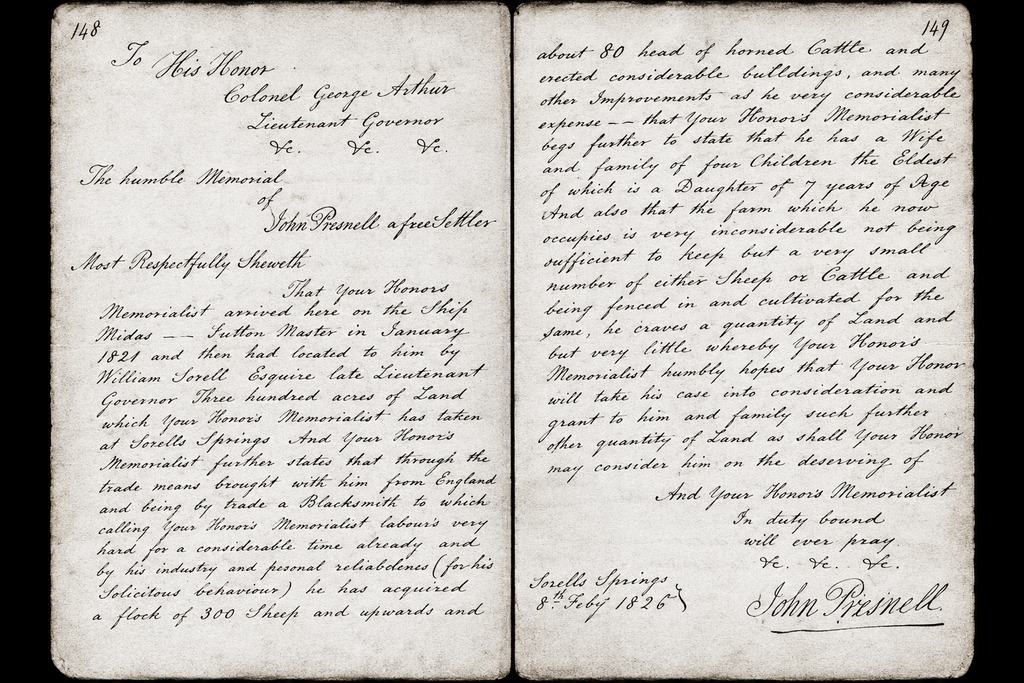
John Presnell’s memorial to Lieutenant-Governor George Arthur, 8 February 1826, recording his arrival aboard the Midas, his 300-acre holding at Sorell Springs, livestock and family circumstances. Archives Office of Tasmania, CSO1/79/1760, pp. 148–149.
By the middle of the 1820s, John had invested considerable effort in developing his property. But the White Hart’s commercial success depended heavily on the road passing its doors, and plans to alter that road would soon threaten his livelihood.
CHAPTER 02 · 1826–1829
A New Inn and a Changing Road
The road that threatened the White Hart
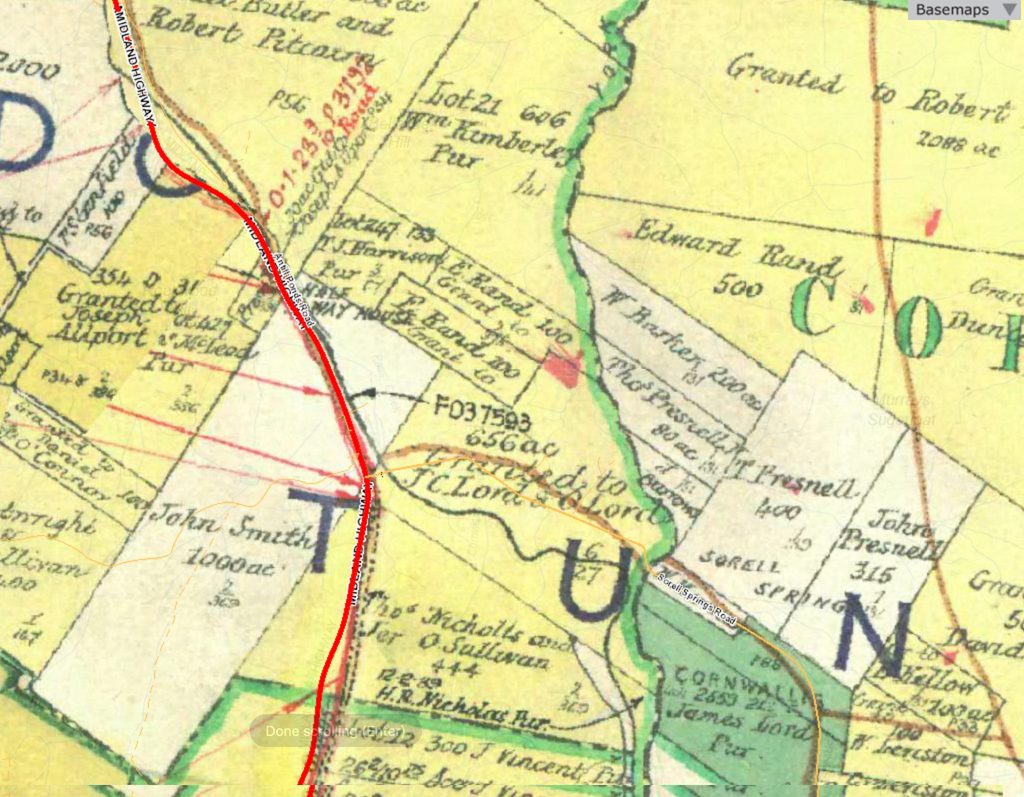
Historical Land District Chart showing early landholdings and roads around Sorell Springs and Antill Ponds, including property associated with the Presnell family and the Half Way House. Source: LISTmap, Land District Chart layer.
During the 1820s, the colonial government began planning improvements to the road between Hobart and Launceston. For John Presnell, whose White Hart Inn at Sorell Springs depended on passing travellers, the proposed changes presented a serious threat.
John learned that the new road would pass approximately three miles from his existing establishment. To protect his business, he purchased another 300 acres at Curryjong Bottom, where the proposed route was expected to pass.
He began constructing a substantial stone building with associated outbuildings, while clearing and fencing approximately 70 acres of land. The investment amounted to several hundred pounds.
But before the new establishment was completed, the government proposed another alteration to the road, leaving John’s new property bypassed as well.
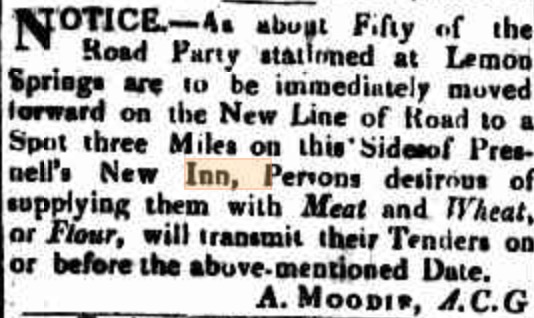
December 1826 — Presnell’s New Inn
By December 1826, John Presnell’s second establishment had become a recognised landmark along the developing Hobart–Launceston road.
A government notice published in the Hobart Town Gazette on 2 December 1826 announced the relocation of approximately fifty road workers from Lemon Springs to a position three miles from “Presnell’s New Inn”.
The reference provides contemporary evidence that the Curryjong Bottom property was already known as a new inn, more than a year before John described his substantial investment in the building in his December 1827 memorial.
Whether the establishment was completed, licensed or opened to travellers remains uncertain.
December 1827 — John appeals to the Governor
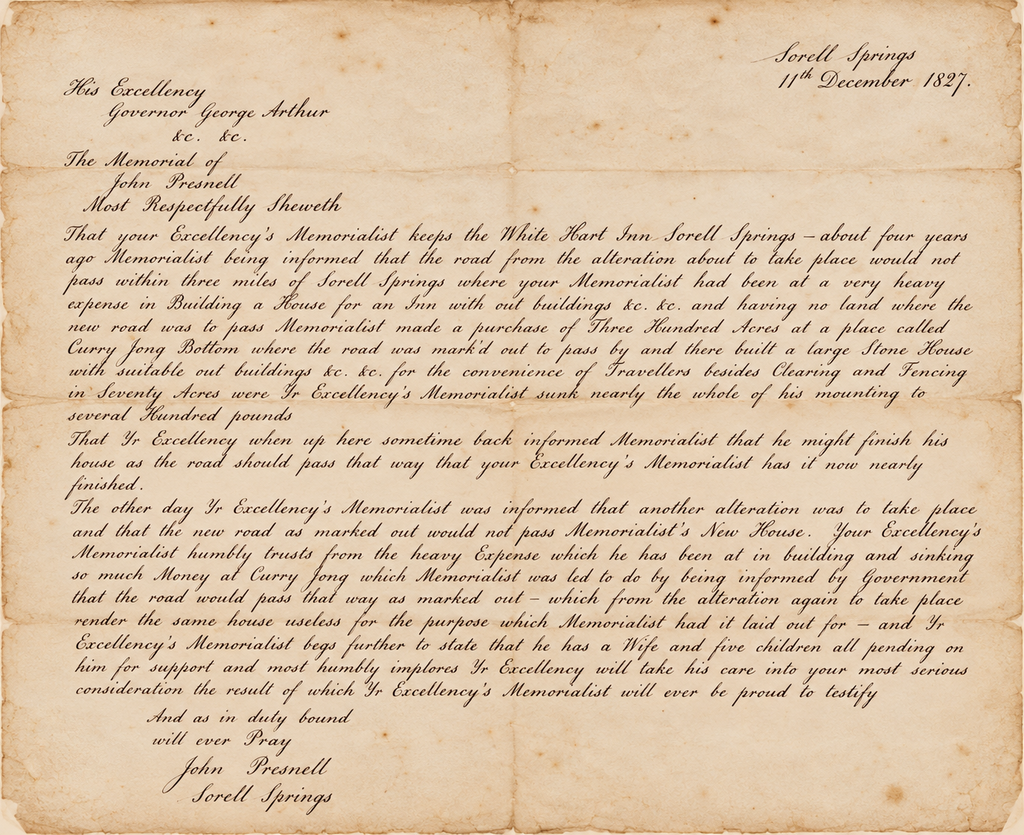
John Presnell’s memorial to Lieutenant-Governor George Arthur, dated 11 December 1827, describing his investment in a new stone building at Curryjong Bottom and the financial consequences of proposed changes to the main road.
On 11 December 1827, John Presnell submitted a memorial to Lieutenant-Governor George Arthur, describing the financial difficulties caused by repeated changes to the proposed road.
John explained that he had operated the White Hart Inn at Sorell Springs for approximately four years before purchasing the Curryjong Bottom property. He had invested heavily in a new stone building, outbuildings and improvements after receiving assurances that the road would pass his land.
When another route was proposed, John feared that the nearly completed building would become useless for its intended purpose. He appealed to the Governor for consideration of the considerable expense he had incurred.
The memorial provides remarkable firsthand evidence of the risks faced by an early colonial innkeeper whose livelihood depended on the location of the main road.
The Second Property at Curryjong Bottom
John’s memorial establishes that a second substantial building was constructed at Curryjong Bottom, separate from the original White Hart Inn at Sorell Springs. The building was described as a large stone house with suitable outbuildings, situated on land purchased specifically because the proposed road was expected to pass nearby. However, the surviving evidence does not establish whether this second establishment was ever completed, licensed or opened to travellers. Its subsequent history remains one of the unanswered questions surrounding the Presnell family’s early inns. The possibility that its stonework was later reused at Antill Ponds warrants further investigation, but has not been confirmed.
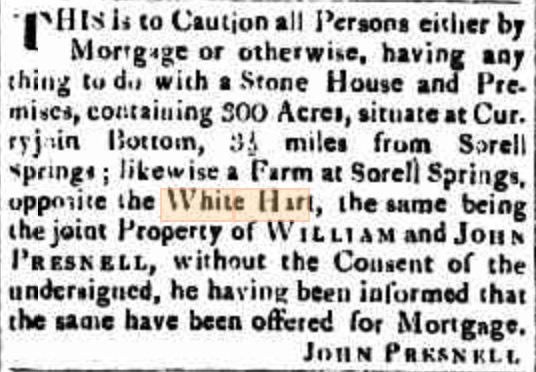
September 1826 — A Stone House at Curryjong Bottom
A Dispute Over the Presnell Properties
A contemporary newspaper notice signed by John Presnell warned against mortgaging a stone house and 300-acre property at Curryjong Bottom, approximately three and a half miles from Sorell Springs, without his consent.
The notice also identified a separate farm opposite the White Hart Inn at Sorell Springs, jointly owned by John and William Presnell.
This provides further documentary evidence of the substantial stone building at Curryjong Bottom and reveals potential financial tensions surrounding the family’s property interests. The precise circumstances of the proposed mortgage remain unknown.
Searching for the Second Property Today
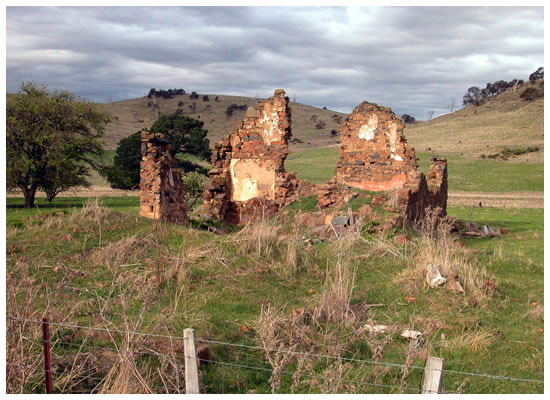
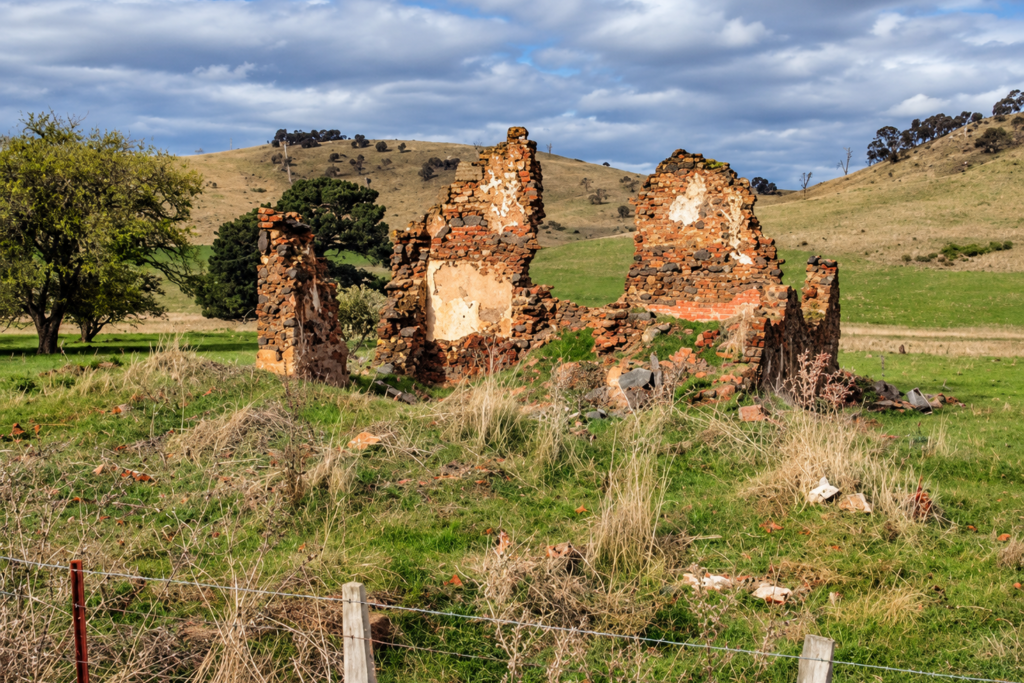
Surviving stone ruins near Antill Ponds Road, photographed in October 2026. The remains are being investigated as a possible location of John Presnell’s second property at Curryjong Bottom, constructed in 1827.
The precise location and eventual fate of John Presnell’s substantial stone house at Curryjong Bottom remain uncertain.
During a visit to the district in October 2026, surviving stone ruins were photographed near Antill Ponds Road, in the vicinity of Pass Creek and Currajong Rivulet.
Their location and substantial stone construction make them a possible candidate for the building described in John’s 1827 memorial. However, no documentary or archaeological evidence has yet established a connection between these ruins and the Presnell property.
Further investigation of historical land boundaries, road alignments and building records may help determine whether the remains are associated with John’s second establishment.
1827 — The White Hart Remains at Sorell Springs
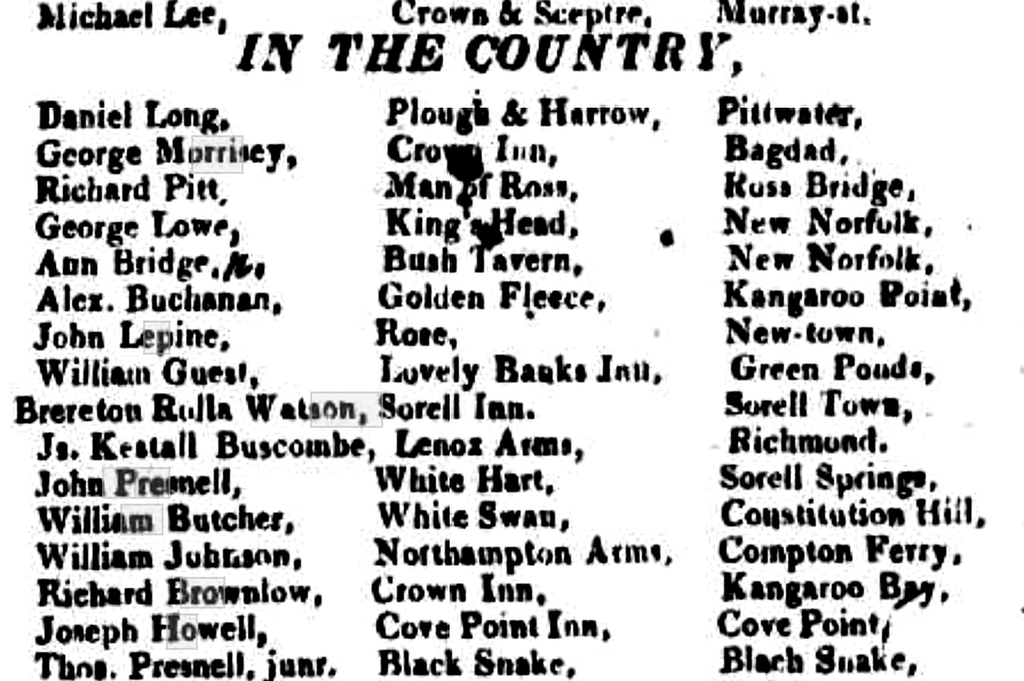
The licensing register for 1827–1828 continued to identify John Presnell as the publican of the White Hart Inn at Sorell Springs.
This is significant because John had already invested in a second stone building at Curryjong Bottom, referred to in a December 1826 government notice as “Presnell’s New Inn”.
The records demonstrate that the original White Hart remained licensed under John’s name while he pursued his plans for a second establishment along the proposed new road.
1827: Conflict at Curryjong Bottom
In October 1827, John Presnell’s newly constructed property at Curryjong Bottom became the setting for a violent encounter between Aboriginal Tasmanians and British settlers.
A contemporary newspaper report, dated 16 October 1827, located the incident at “Mr Presnell’s new house”, approximately three and a half miles from Sorell Springs.
This was almost certainly the substantial stone house John described in his December 1827 memorial to Lieutenant-Governor George Arthur. The newspaper also records that District Constable Bennett was residing there, suggesting the building was already occupied before its completion.
According to the report, District Constable Bennet, who was residing at the property, and a visiting Captain Clark encountered a group of Aboriginal people nearby. Both men were reportedly wounded by spears, with Bennet described as dangerously ill.
The correspondent attributed the encounter to a group associated with a man identified as Black Tom. This identification, and the newspaper’s description of the events, reflect the account of a colonial correspondent and have not been independently verified.
The incident occurred against the background of the Black War, as the expansion of European settlement onto Aboriginal lands led to dispossession, resistance and increasingly violent confrontations.
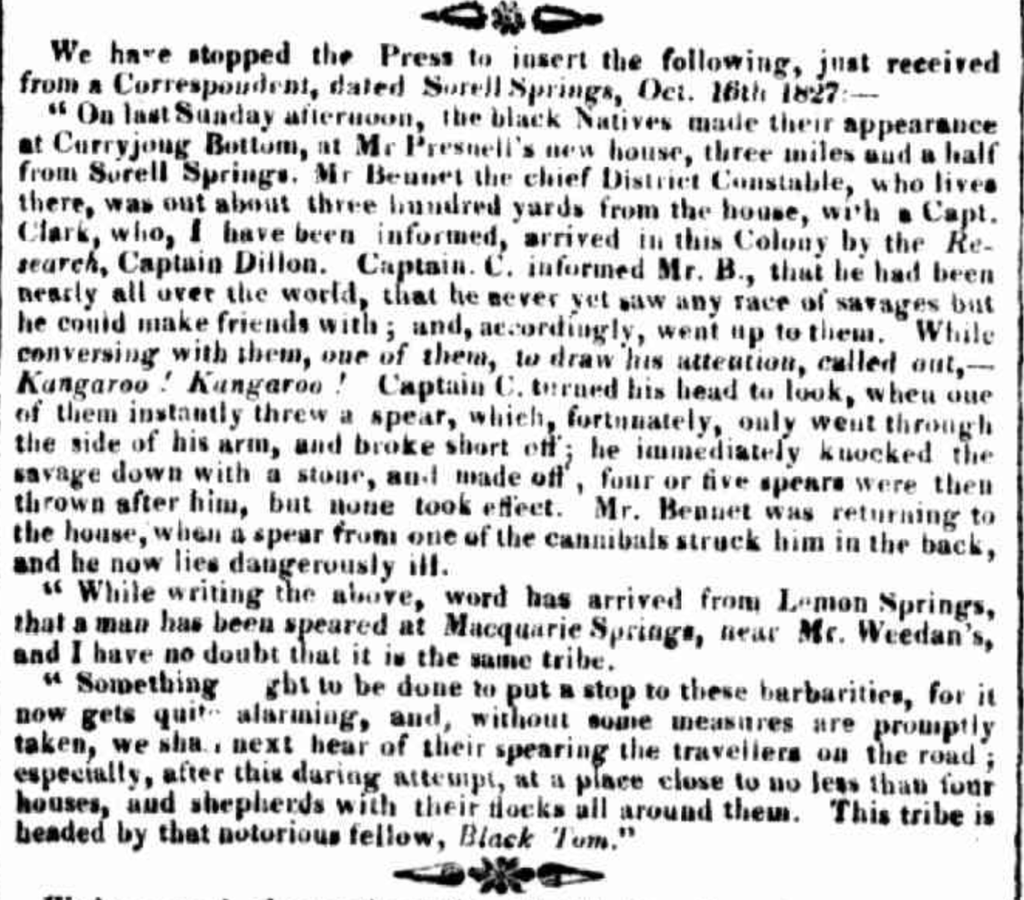
Newspaper report dated 16 October 1827 describing an encounter between Aboriginal Tasmanians and British settlers near John Presnell’s new house at Curryjong Bottom. The report identifies District Constable Bennett as a resident of the property.
Although there is no evidence in this report that John was personally involved in the confrontation, it establishes that his property was directly associated with an episode of the wider colonial conflict.
A further newspaper report in March 1830 described Aboriginal people passing near “Presnell’s new house” in the Oatlands district. Although the property was not precisely identified, the reference may concern the same substantial stone building at Curryjong Bottom mentioned in the 1827 accounts.
1829 The Presnell partnership
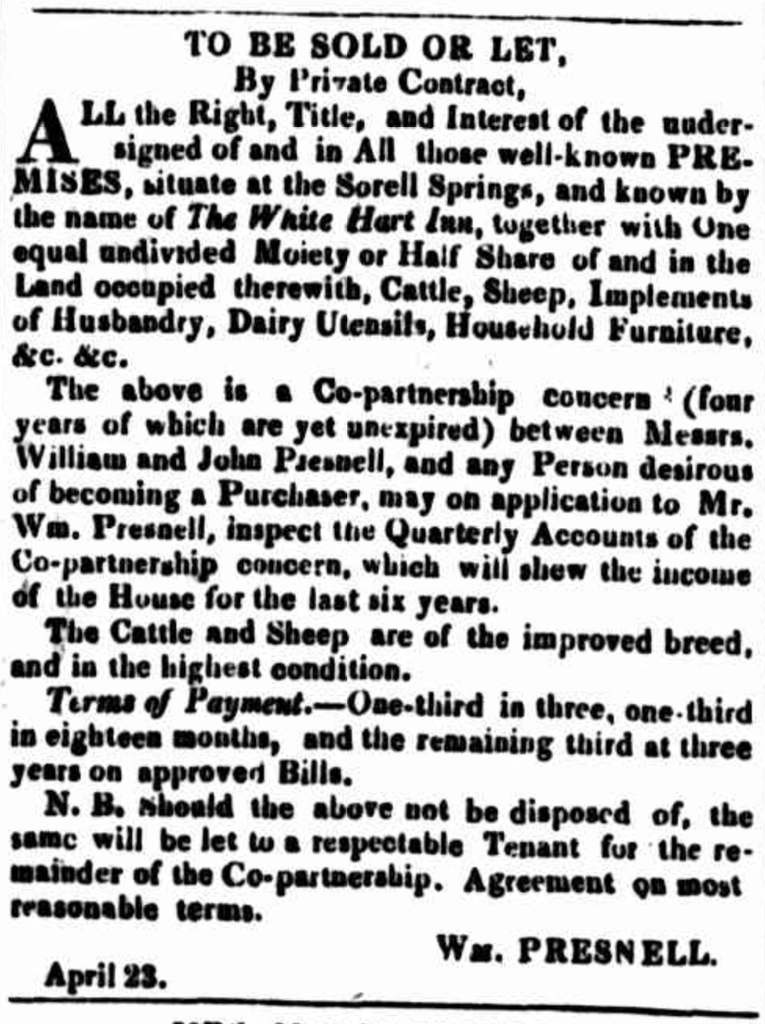
William Presnell offers his undivided half-share in the White Hart Inn partnership at Sorell Springs for sale or lease, together with associated farming property and equipment. Newspaper advertisement, 23 April 1829.
By 1829, the White Hart Inn at Sorell Springs was operating as part of a partnership involving John and William Presnell.
An advertisement dated 23 April 1829 offered William’s undivided half-share in the business and associated property for sale or lease. The offering included land, livestock, farming implements, dairy equipment and household furniture.
The notice also referred to the partnership’s financial accounts and an agreement with four years remaining, demonstrating the substantial commercial arrangements associated with the inn.
The reason William wished to dispose of his interest remains uncertain. Nevertheless, the advertisement provides valuable evidence of the family’s continuing investment at Sorell Springs, even as John pursued opportunities along the proposed new road.
May 1829 — The White Hart Faces a Sheriff’s Sale
Only five weeks after William Presnell advertised his half-interest in the White Hart partnership for sale, legal proceedings involving a Presnell threatened the family’s property at Sorell Springs.
On 29 May 1829, the Colonial Times advertised a sheriff’s auction of approximately 200 cattle and the defendant’s interest in the farm and house formerly known as the White Hart Inn. A subsequent notice, dated 4 June, again advertised the property for sale.
Both notices identified proceedings titled Adey v. Presnell and Lester v. Same. The defendant’s first name was not given, and whether either proposed auction proceeded remains unknown.
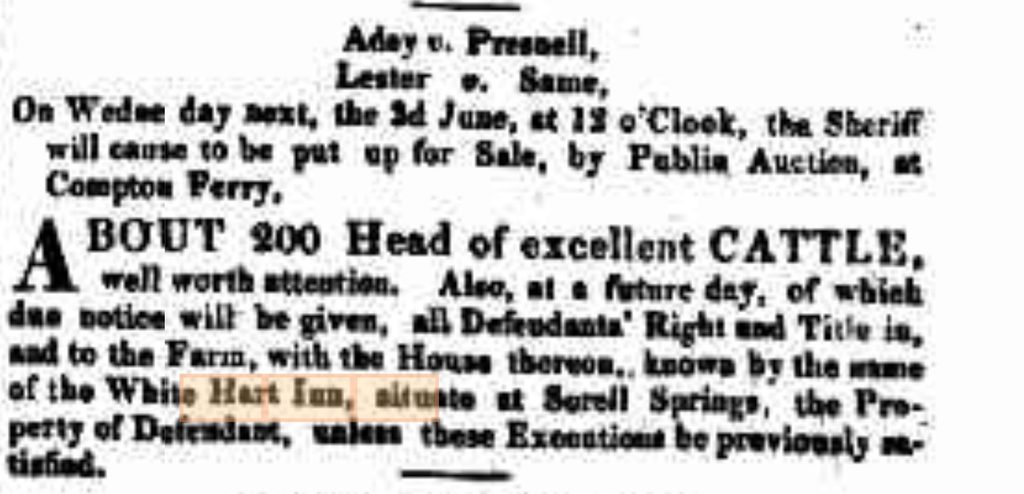
Sheriff’s auction notice advertising cattle and property interests associated with the former White Hart Inn at Sorell Springs, May 1829.
September 1829 — The Partnership Dissolved
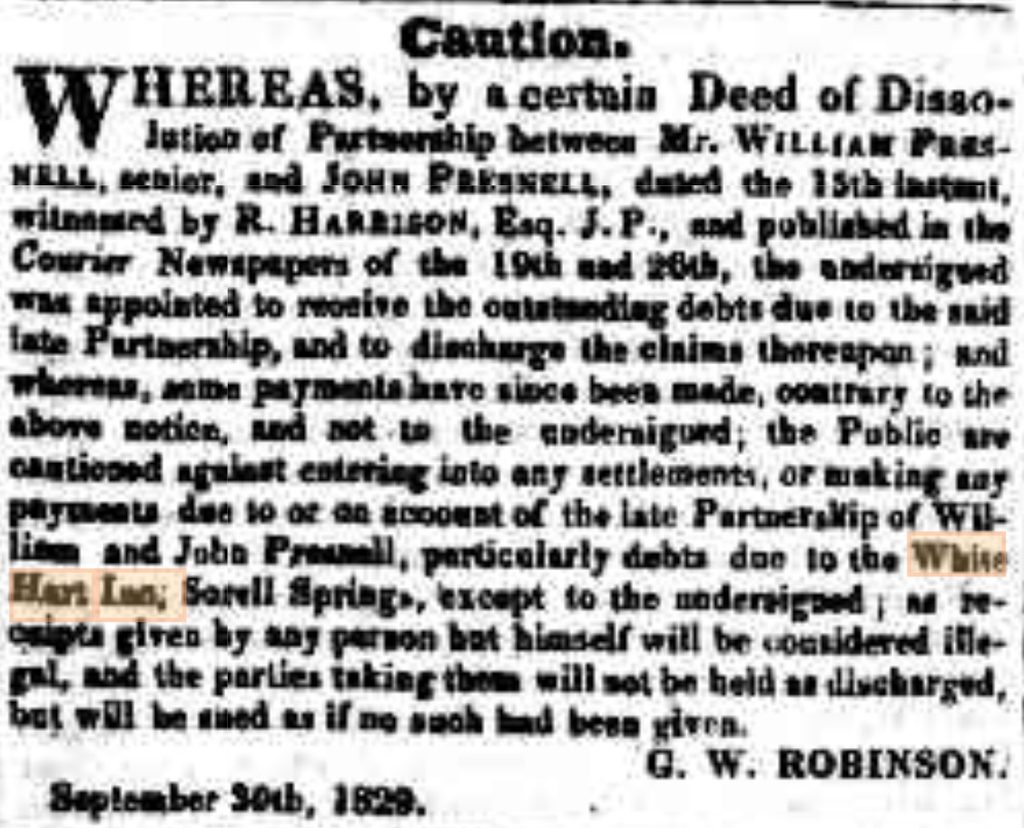
Public notice confirming the dissolution of the partnership between William and John Presnell and the appointment of G. W. Robinson to manage outstanding accounts, September 1829.
The partnership between William Presnell senior and John Presnell was formally dissolved by deed in September 1829, bringing their longstanding business arrangement to an end.
The dissolution followed a period of financial difficulties within the extended family. William’s son-in-law, George William Robinson, had previously operated the Tasmanian Inn in Hobart and had been involved in insolvency proceedings. William had also reportedly sold his Hobart property interests earlier in 1829.
In a public notice dated 30 September, Robinson announced his appointment to collect outstanding debts and settle claims arising from the former Presnell partnership, particularly those associated with the White Hart Inn at Sorell Springs.
Although the reasons for the dissolution remain uncertain, the notice establishes that the partnership had formally ended before John opened the White Hart Inn at Antill Ponds in 1830.
CHAPTER 03 · 1830–1832
A New Beginning at Antill Ponds
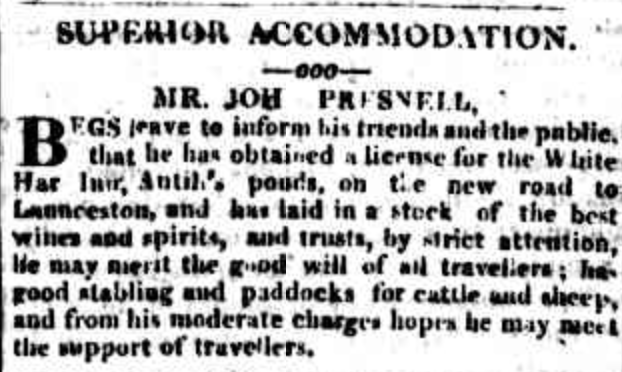
John Presnell announces the opening of the White Hart Inn at Antill Ponds, offering accommodation, stabling and paddocks beside the new road to Launceston. Hobart Town Courier, 16 October 1830.
By October 1830, John Presnell had established the White Hart Inn at Antill Ponds, beside the improved main road between Hobart and Launceston.
On 16 October 1830, an advertisement appeared in the Hobart Town Courier under the heading “Superior Accommodation.” John announced that he had obtained a licence for the White Hart Inn at Antill Ponds and was ready to accommodate travellers.
The advertisement promoted the facilities available to guests, including accommodation, stabling and paddocks for their horses and livestock.
For John, the establishment at Antill Ponds represented an opportunity to recover the passing trade threatened by the changes to the original road through Sorell Springs.
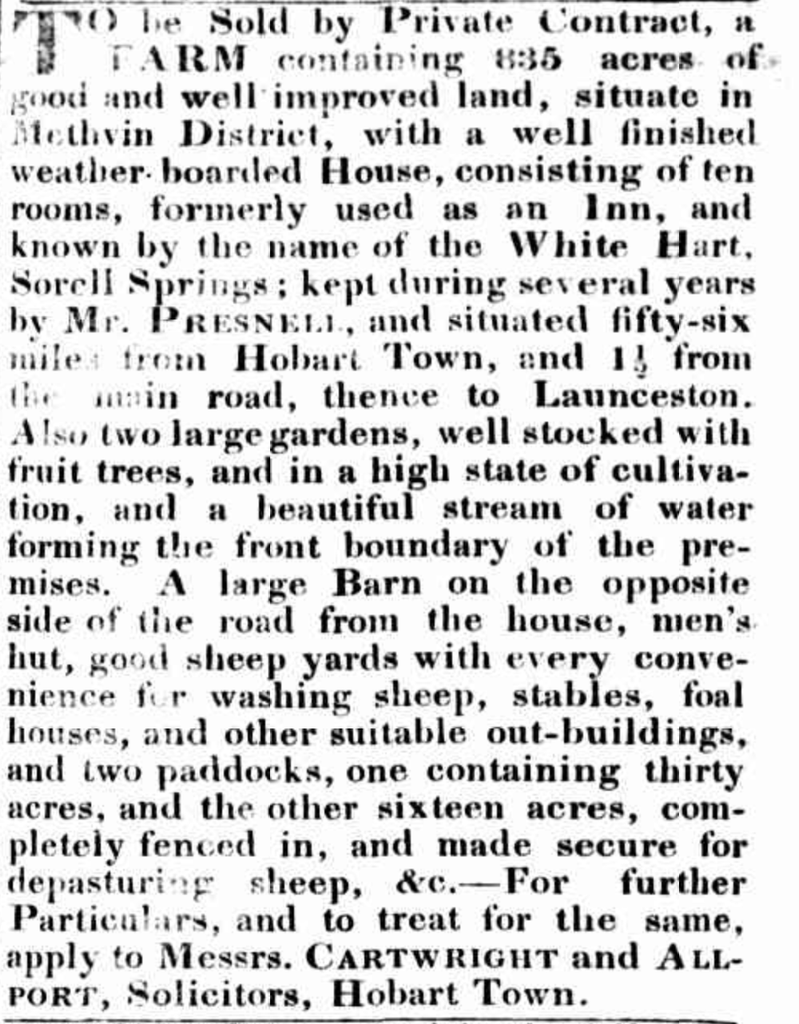
Advertisement offering the former White Hart Inn property at Sorell Springs for sale, including its ten-room weatherboard house, gardens, outbuildings and farmland. The Colonist, 30 November 1832.
1832 – The Original White Hart Remains at Sorell Springs
The 1832 advertisement and an 1833 tenancy letter confirm that the original White Hart building remained at Sorell Springs after John Presnell established his new inn at Antill Ponds. This challenges later accounts suggesting the entire original building was dismantled and relocated. One possibility is that materials from John’s substantial stone house at Curryjong Bottom were reused at Antill Ponds, although no contemporary evidence has yet confirmed this.
1830: The Black Line
In October 1830, the colonial government organised the Black Line, a large military operation intended to capture Aboriginal Tasmanians by sweeping across settled districts towards the Tasman Peninsula. Soldiers, police, convicts and settlers participated in the campaign.
The operation took place during the Black War, a period of violent conflict arising from British colonisation, Aboriginal dispossession and resistance.
The Presnell family’s properties at Sorell Springs and Antill Ponds lay within the broader Midlands region affected by these events. A later family history describes military posts near land occupied by the Presnells and neighbouring settlers, including John Vincent.
The same account suggests that John Presnell supplied provisions to parties stationed in the district. This possible involvement remains to be verified against contemporary government records.
Although the Black Line failed to achieve its immediate objective, it formed part of the wider colonial campaign that ultimately resulted in the forced removal of many Aboriginal Tasmanians from their homelands.
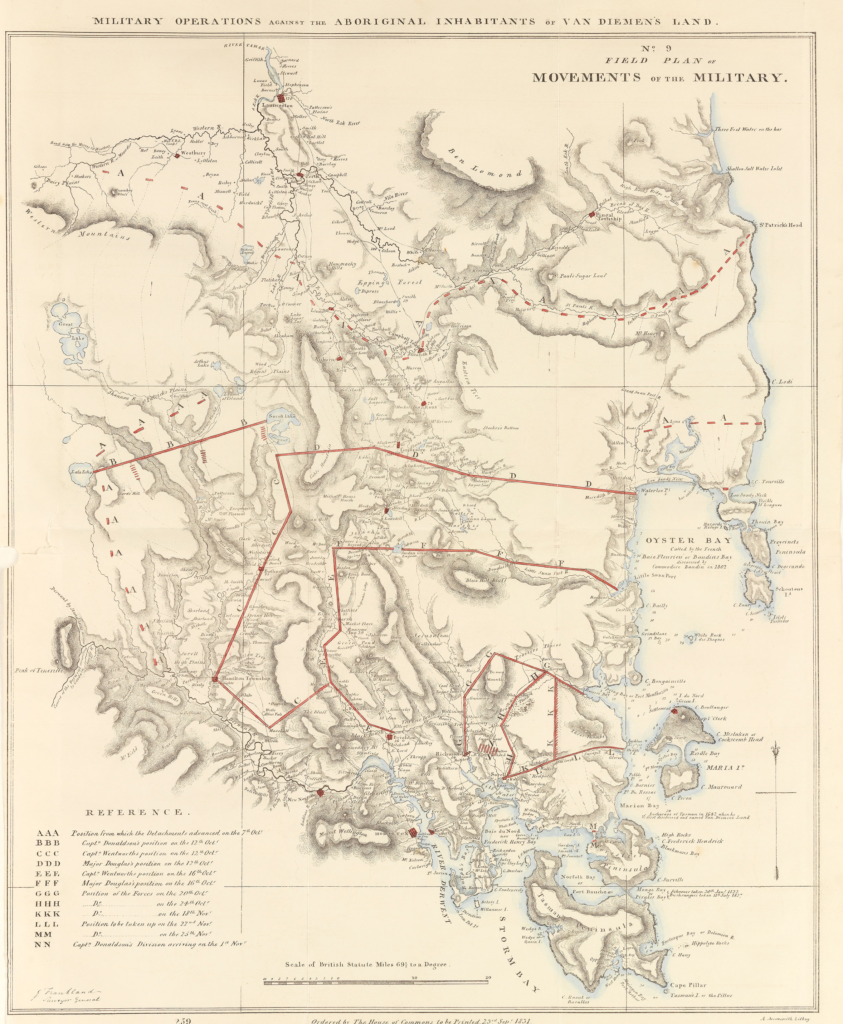
Map showing the movements of colonial forces during the Black Line campaign of 1830, including operations across Tasmania’s Midlands. Published by order of the British House of Commons, 23 September 1831.
CHAPTER 04 · 1831–1835
Eleanor Presnell — Keeping the White Hart Alive
1831 — The Death of John Presnell
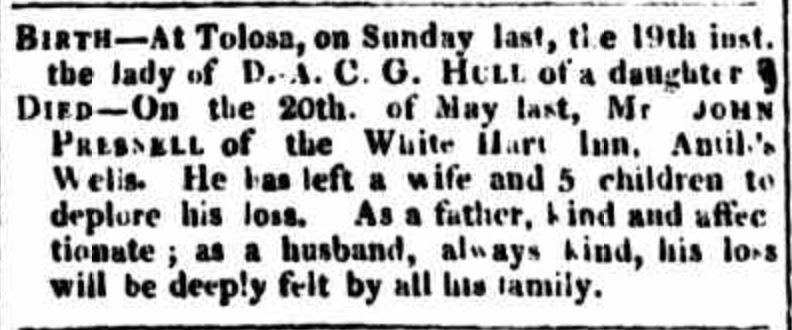
Death notice for John Presnell, who died at the White Hart Inn, Antill Ponds, on 20 May 1831. Hobart Town Courier, 25 June 1831..
John Presnell died on 20 May 1831 at the White Hart Inn, Antill Ponds, aged approximately 45. He had operated the new establishment for only seven months.
His death notice, published in the Hobart Town Courier on 25 June 1831, recorded that he left a wife and five children. It described him as a kind and affectionate husband and father whose loss would be deeply felt by his family.
After years of investment in roadside inns, farmland and the changing route between Hobart and Launceston, John died just as his latest venture was becoming established.
1833 — Eleanor Presnell Becomes Licensee
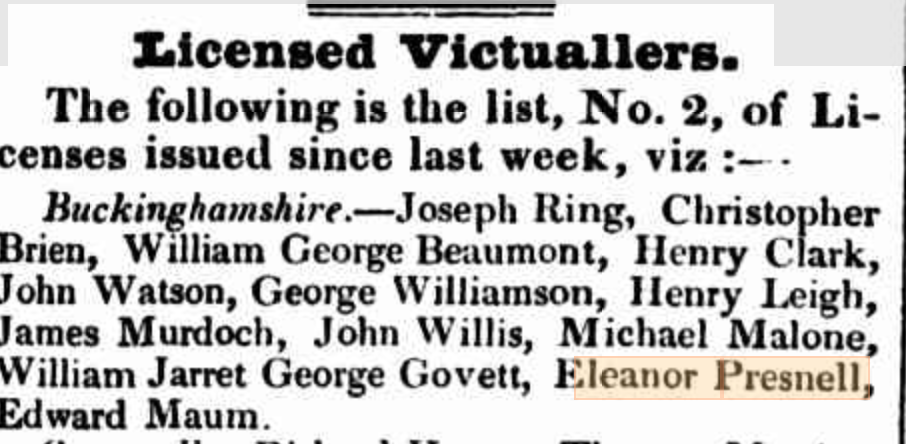
Following John’s death, his widow Eleanor continued the family’s involvement in the White Hart Inn at Antill Ponds.
A licensing notice published in The Colonist on 17 December 1833 lists Eleanor Presnell among the licensed victuallers in Buckinghamshire. This confirms her continued involvement in the licensed hospitality trade following John’s death, although the notice does not identify the establishment concerned.
With five children to support, Eleanor maintained the family’s connection with the hospitality business established by her husband.
CHAPTER 05 · 1838–1975
The Half Way House — A Changing Landmark
1838 — The White Hart Offered for Sale
In January 1838, the White Hart Inn at Antill Ponds and associated land were advertised for sheriff’s sale following legal proceedings involving the estate of John Presnell, who had died in 1831.
A further advertisement in May 1838 offered the inn and approximately 415 acres of surrounding land for public auction in three lots.
The White Hart itself occupied 30 acres divided by the Launceston road. Described as being in full trade, it had been leased for several years to David Solomon at an annual rent of £140.
Two additional parcels comprised 207 acres occupied by Thomas Presnell and 178 acres occupied by John Presnell, both described as productive agricultural land.
The advertisements reveal the substantial property interests associated with the White Hart and demonstrate that members of the Presnell family continued farming in the district after their direct involvement in operating the inn had ended. Neither notice establishes whether the proposed auctions resulted in completed sales.
A separate licensing notice from 1838 confirms that David Solomon held the liquor licence for the White Hart Inn at Antill Ponds, providing further evidence that he continued operating the establishment during this period.
Auction advertisement offering the White Hart Inn and 415 acres at Antill Ponds in three lots, including farmland occupied by Thomas and John Presnell. Colonial Times, 15 May 1838..
The White Hart continued serving travellers under subsequent proprietors, but its earliest years had been shaped by the Presnell family.
During the years following the Presnell family’s involvement, the inn became widely known as the Half Way House.
The name reflected its position along the route between Hobart and Launceston, where generations of travellers stopped during their journeys through the Midlands.
The establishment continued operating through changing times, including the development of organised coach services and improvements to the colony’s transport network.
The White Hart also served as a gathering place for official government business. In a public notice, Oatlands Police Magistrate John Whitefoord designated the inn at Antill Ponds as one of four locations for the annual muster of ticket-of-leave convicts. The notice required eligible men living nearby to attend at 10 am on 28 September, illustrating the inn’s role in the administration of the surrounding district.
1852 — Fire and Reconstruction
The original inn buildings underwent alterations and rebuilding, particularly following a destructive fire in 1852.
Eventually, the establishment ceased operating as a licensed hotel.
The Half Way House in Later Years
1975 — Demolition of the Historic Hotel
The remaining buildings were demolished in 1975, leaving only traces of what had once been an important roadside stopping place.
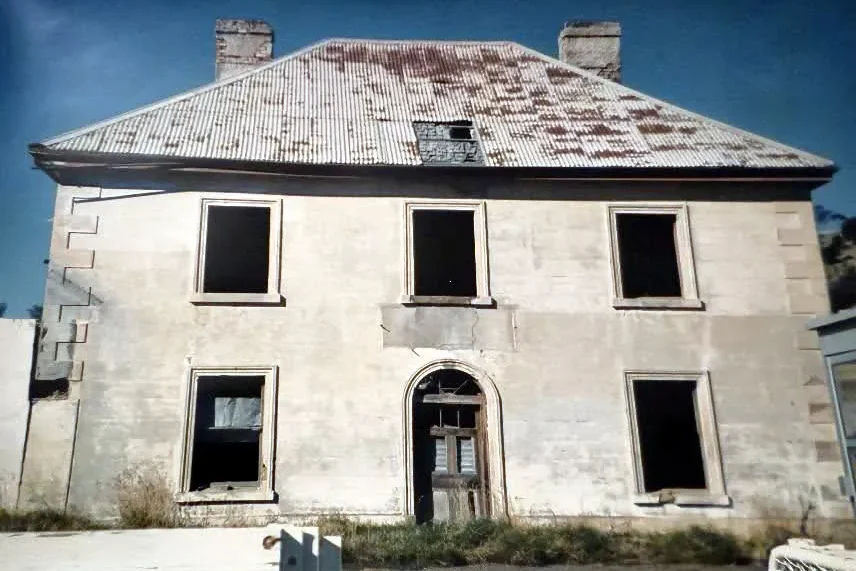
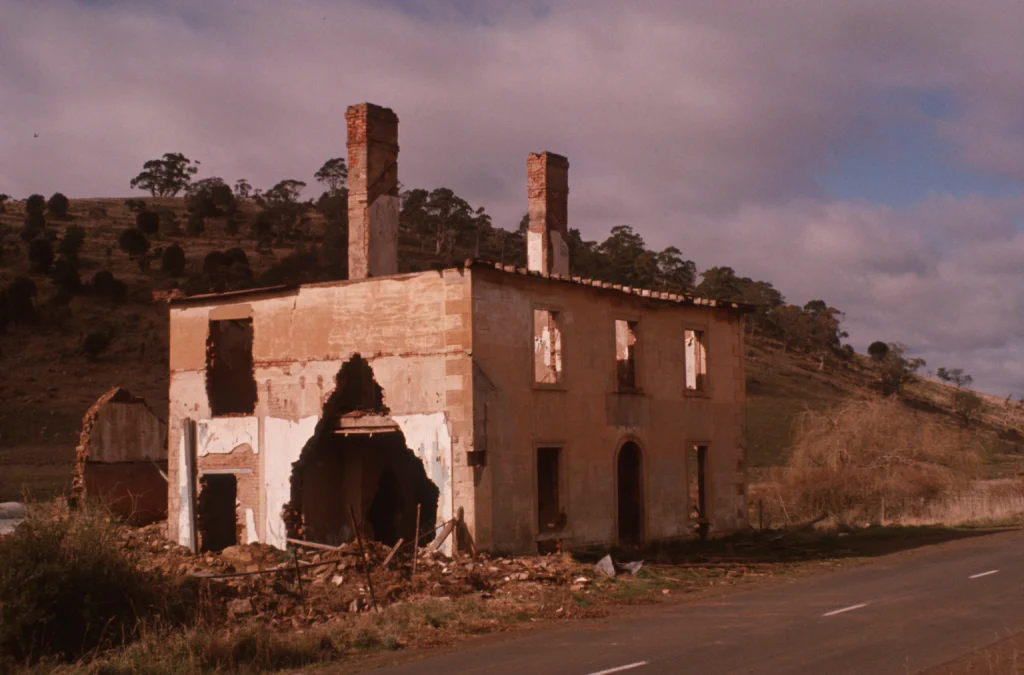
Locating the White Hart Inn Today.
Although the White Hart Inn has long since disappeared, historical photographs provide valuable clues to its location and the buildings that once occupied the site.
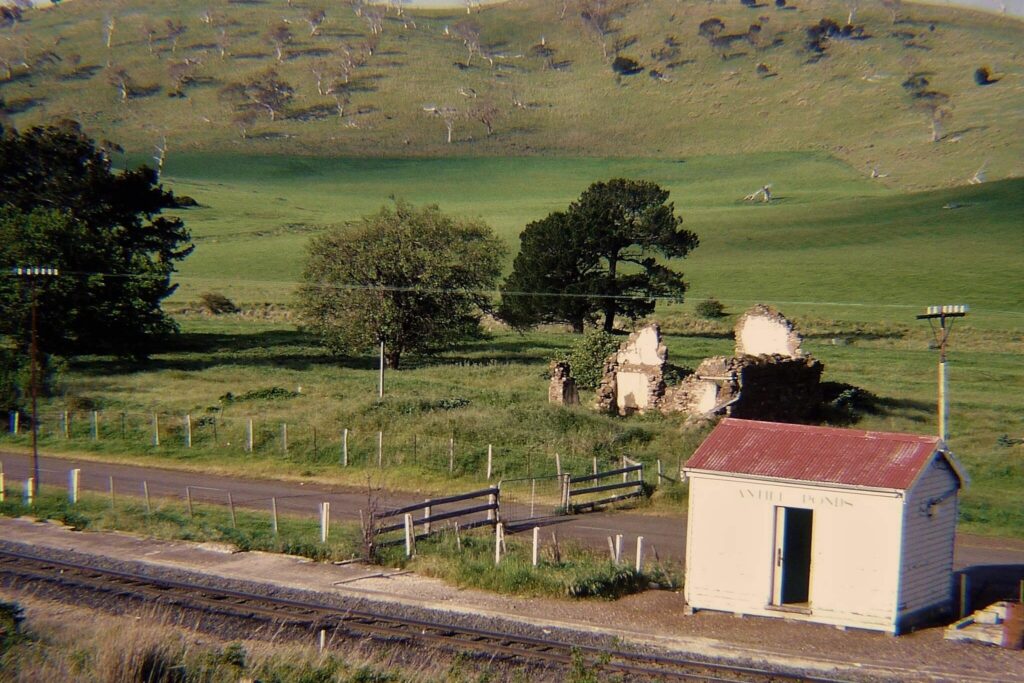
A photograph of Antill Ponds railway station shows the two-storey Half Way House standing across the road from the railway precinct. The building, originally established as the White Hart Inn by John Presnell in 1830, remained a prominent landmark long after the Presnell family’s involvement had ended.
Another photograph, taken from a different angle, reveals substantial masonry ruins in a paddock beyond the station. These appear consistent with ruins recorded in a separate photograph of the surrounding landscape.
Their exact purpose remains uncertain. They may have belonged to an outbuilding associated with the inn, possibly stables or accommodation, or represent remains of the main establishment following demolition.
Whatever their original function, these photographs help reconnect the Presnell family’s story with the landscape of Antill Ponds, where John and Eleanor Presnell operated their roadside inn nearly two centuries ago.
The Presnell Legacy
The White Hart Inn represents a significant chapter in the early history of the Presnell family in Tasmania.
John Presnell arrived in Van Diemen’s Land as a skilled tradesman and became a landholder and innkeeper.
When changes to the main road threatened his business, he adapted by establishing a new inn at Antill Ponds.
Following his death, Eleanor continued the enterprise, demonstrating determination and resourcefulness during a difficult period for the family.
Other members of the Presnell family maintained connections with the surrounding farmland, while the inn itself remained an important commercial property until its sale in the late 1830s.
Nearly two centuries later, the buildings have disappeared, but the surviving newspaper advertisements, land records and historical research preserve the family’s contribution to the development of Tasmania’s Midlands.
For descendants of the Presnell family, the White Hart Inn is more than a vanished colonial hotel.
It is a reminder of the opportunities, hardships and determination that shaped the lives of their ancestors in early Van Diemen’s Land.
Historical Sources and Further Reading
R. H. Green — Antill Ponds and the Half Way House
Queen Victoria Museum and Art Gallery, 1997. Historical study of the Antill Ponds district, its early landholders and roadside inns.
Mick Roberts — Exploring the Legacy of Halfway House Antill Ponds
Time Gents, 2 October 2025. Detailed historical account incorporating early newspaper advertisements and subsequent history of the establishment.
The Hobart Town Courier — 16 October 1830
John Presnell’s advertisement announcing the White Hart Inn at Antill Ponds.
The Hobart Town Courier — 1831
Death notice for John Presnell, who died at the White Hart Inn on 20 May 1831.
The Hobart Town Courier — 30 November 1832
Advertisement for the former White Hart Inn property at Sorell Springs.
Tasmanian colonial licensing records — 1833
Eleanor Presnell’s licence to sell wine and spirits.
The Hobart Town Courier — 1838
Auction advertisement for the White Hart Inn and associated land at Antill Ponds.
Tasmanian Heritage Register — Rockwood
Historical information about early land grants, property ownership and the Presnell family’s associated landholdings.