Eleanor Skelton
c. 1788–1834 · England and Van Diemen’s Land
MY FAMILY CONNECTION
4th great-grandmother
Eleanor came to Van Diemen’s Land with her husband John and their children in 1821. After John died, she carried on the White Hart Inn at Antill Ponds in her own name.
BORN
About 1788
England
Arrived in Van Diemen’s Land
12 January 1821
Hobart aboard the Midas
DIED
3 Feb 1834
Antill Ponds, Tasmania
CHAPTER 01 · 1807–1821
Marriage and Family in England
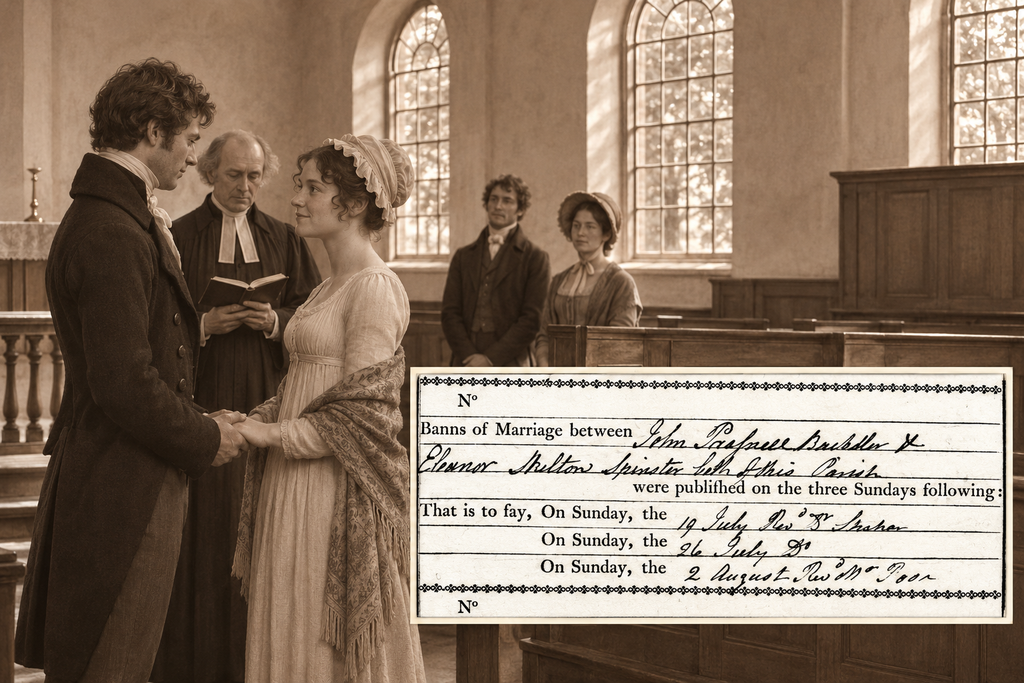
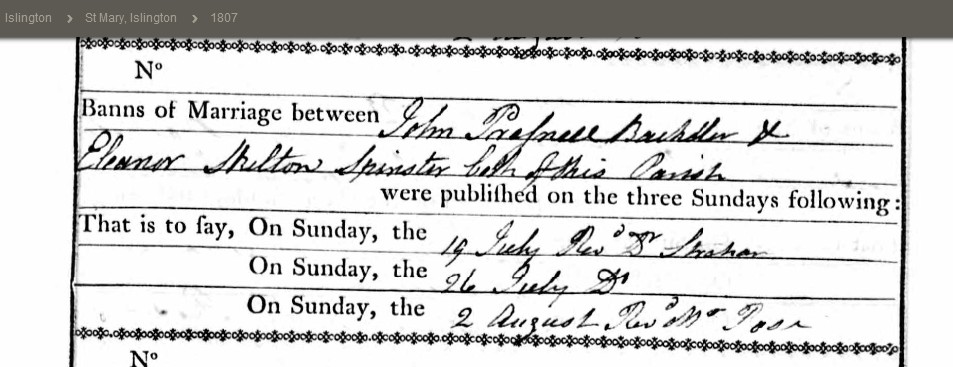
John Presnell and Eleanor Skelton exchange vows at St Mary’s, Islington, in 1807. The wedding scene is a reconstruction, and the inset shows the original parish entry announcing their marriage banns.
Eleanor Skelton and John Presnell married by banns on 21 September 1807. Over the next thirteen years they raised a family in London. Christiana was born in 1808, followed by John in 1814, Frederick in 1817 and Eleanor Elizabeth in 1819. Their youngest daughter was still a toddler when Eleanor and John left England with their family aboard the Midas. They reached Hobart in January 1821.
CHAPTER 02 · 1821–1831
A New Life in Van Diemen’s Land
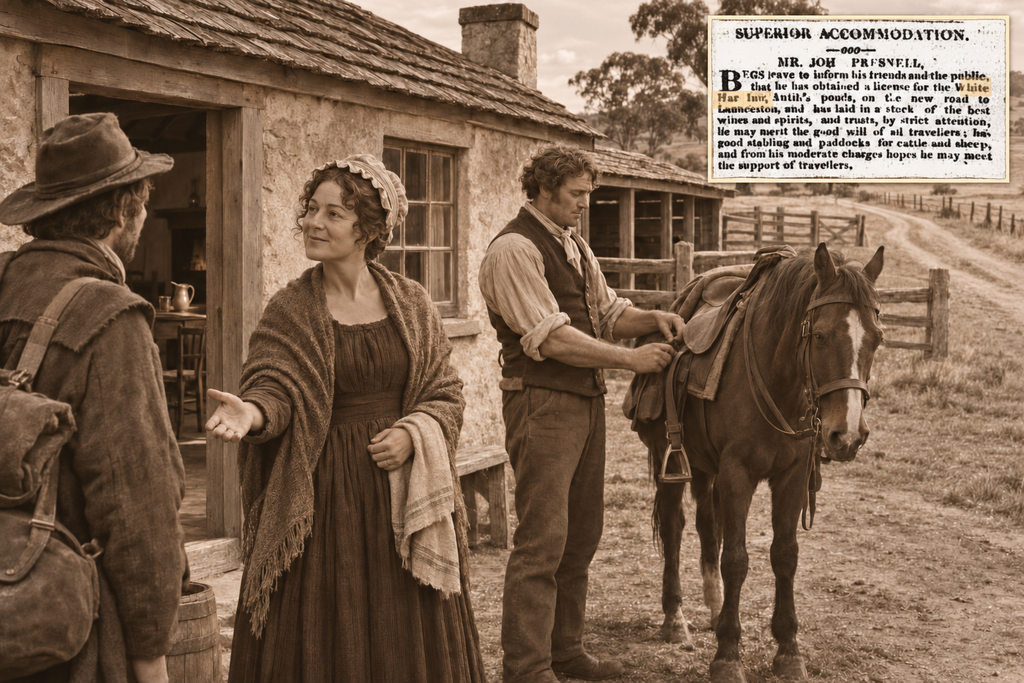
In 1830, John Presnell advertised the White Hart at Antill Ponds on the new road to Launceston.
Eleanor and John made their home in the Tasmanian Midlands, where John kept the White Hart at Sorell Springs. As the family settled into life in the colony, their daughter Christiana married Thomas Presnell Jr at New Norfolk in 1826, bringing two branches of the Presnell family together.
When the main road to Launceston was realigned through St Peter’s Pass, the inn business moved to Antill Ponds. Travellers could find refreshments there, along with stabling for their horses and paddocks for their stock. John died on 20 May 1831, leaving Eleanor with a family to support and an inn to keep.
That same year, Eleanor and John’s son William was born in Van Diemen’s Land.
CHAPTER 03 · 1831–1834
Keeping the White Hart
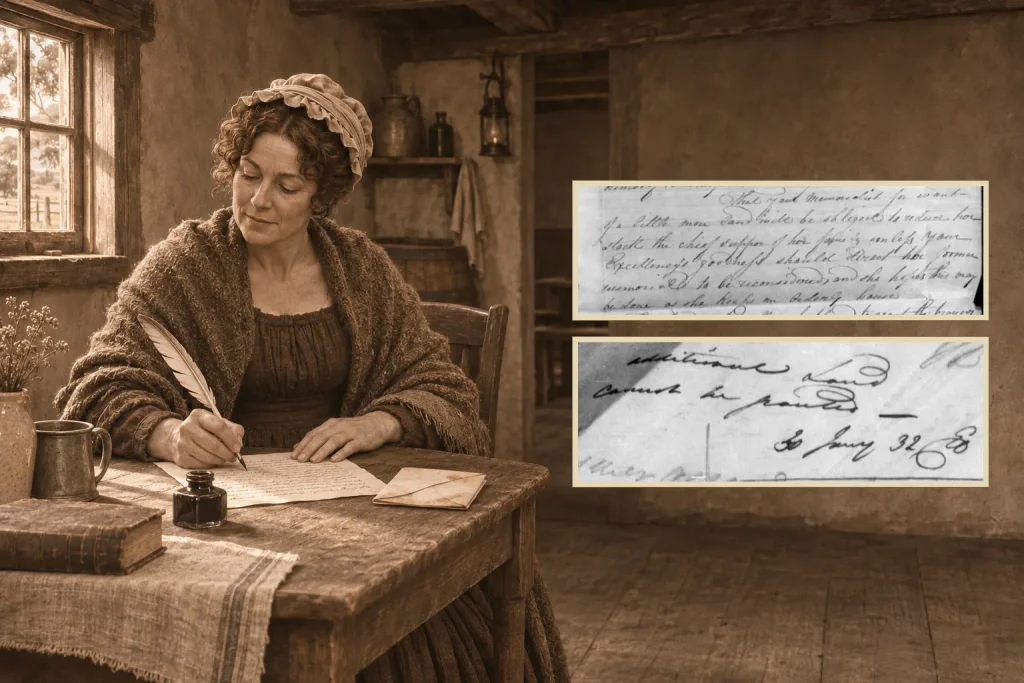
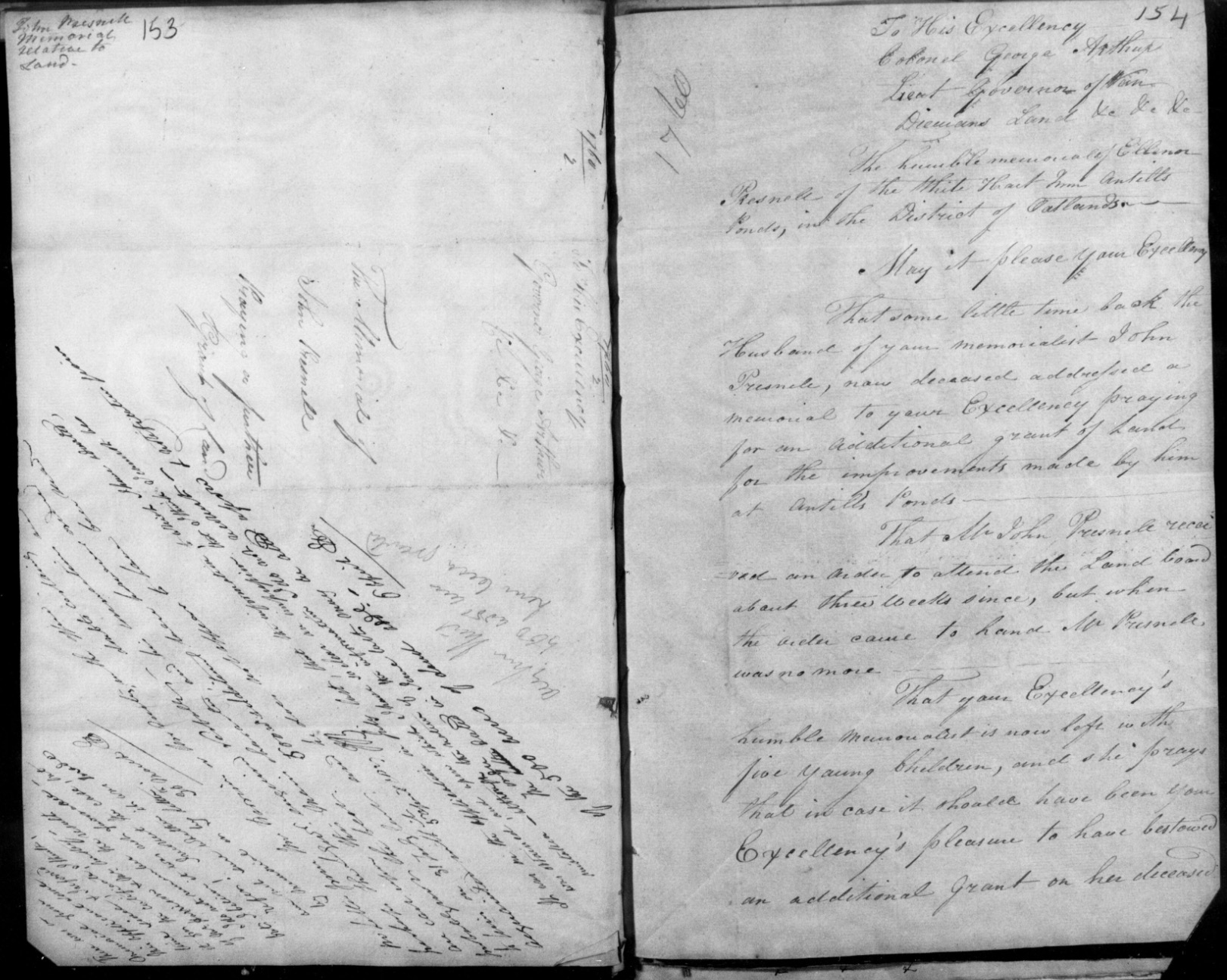
In this reconstruction, Eleanor Presnell writes her January 1832 appeal for more land at the White Hart Inn. The upper inset shows why her family depended on its livestock. The lower inset shows the refusal written on the back of her petition on 30 January 1832.
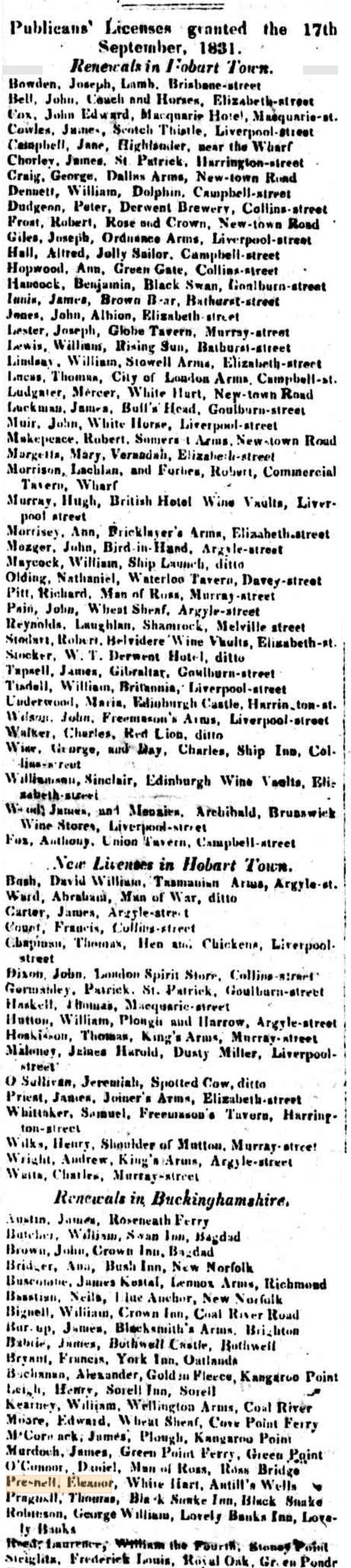
When John died on 20 May 1831, Eleanor carried on the White Hart Inn at Antill Ponds. She also took up the application for more land that John had been pursuing since the 1820s. In June she told Lieutenant-Governor George Arthur that the order for John to appear before the Land Board had arrived after his death. Left with five young children, she asked that any land John would have been granted be granted to her. By September, the publican’s licence for the White Hart had been renewed in her name.
An Appeal for More Land
When John received 300 acres at Sorell Springs, a settler could obtain land from the Crown without paying a purchase price. By 1828, officials assessed what applicants could bring to the land. Livestock and farm implements counted as capital, and settlers seeking more acreage had to show what they had spent improving their existing land and what means they still had to develop another holding. That is why John’s applications read like inventories of the family’s work, listing buildings, fencing, cultivation and stock. This system extended British settlement across lands taken from Aboriginal Tasmanians.
In 1831, Britain directed the colony to sell Crown land by public auction. The starting price was generally five shillings an acre. At that rate, 500 acres would cost at least £125 before any competing bids. Under the old rules, improvements and livestock could help a settler qualify for a grant. At auction, the successful bidder had to pay for the land.
Eleanor’s application came before the Land Board as the rules were changing. In November 1831, her eldest son, also named John, told the Board that his mother was still running the White Hart. Taking into account the young family she had to support, the Board recommended 500 acres under the 1828 regulations. Lieutenant-Governor George Arthur refused the grant.
Eleanor asked him to reconsider in January 1832. John had made his improvements in reliance on the old rules, she argued. Without more land, she would have to reduce the livestock she called “the chief support of her family.” She added that she kept “an orderly house.” Ten days after she dated her petition, the decision was written on the back. “Additional Land cannot be granted.”
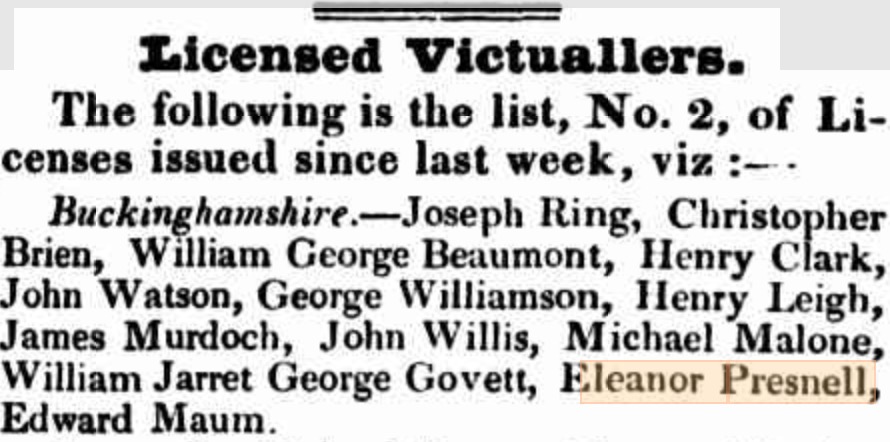
Eleanor was still listed among the publicans issued licences in Buckinghamshire in December 1833. By 21 February 1834, a newspaper notice referring to her family’s grant at Sorell Springs called her the “late Widow Presnell.”
CHAPTER 04 · 2026
A View From My Beer
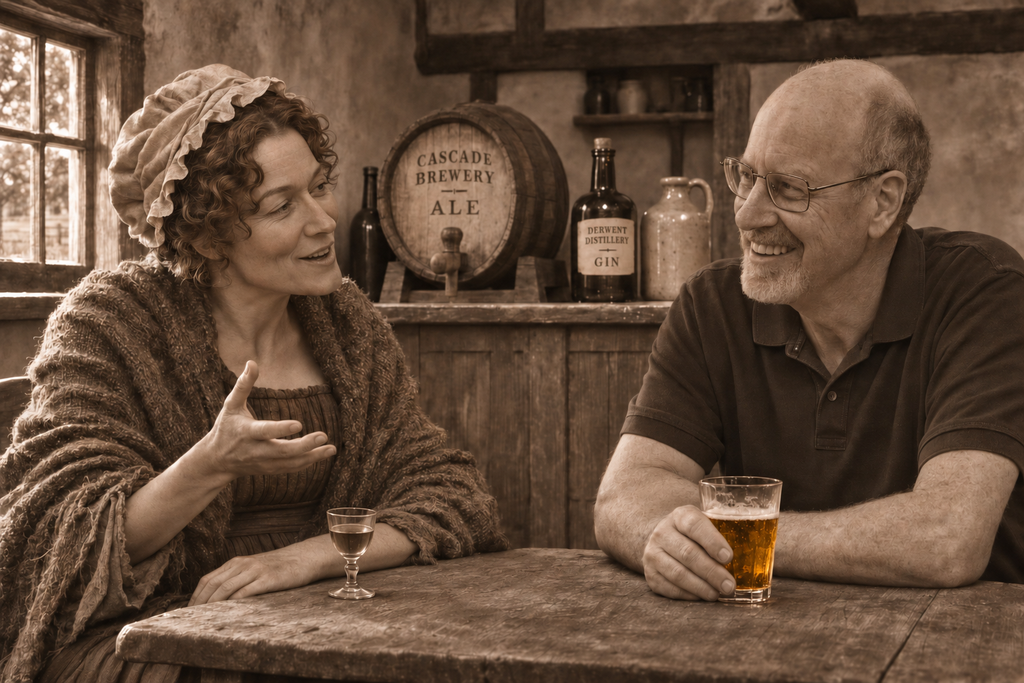
An imagined conversation with my fourth great-grandmother, Eleanor Skelton, over sherry and a beer at the White Hart Inn, Antill Ponds, c. 1832.
If I could sit down with Eleanor, I’d do it at the White Hart. A sherry for her, a beer for me. I’d wait until the last traveller had been seen to and ask her to sit down for a while. I’d bring her a copy of the letter she sent to George Arthur. I can read what she told him about the livestock and what the clerk wrote on the back. What I’d really like to hear is what she did the next morning. Did she talk it over with Christiana? Had she already worked out how to get by with the land they had? And before I left, I’d ask her to tell me a story about Christiana as a girl. I know the dates that connect us. I’d love to hear the story Eleanor would have told across the table.
Eleanor’s petitions tell us what mattered to her after John’s death. The histories below place those letters in the wider story of the Presnell family’s migration, the White Hart Inn at Antill Ponds and the changes to land grants in Van Diemen’s Land.
- The Presnells’ migration and settlement. Colin Mallett traces John and Eleanor’s arrival aboard the Midas, their life in the Midlands and Eleanor’s efforts to secure more land after John’s death. I’ll meet you halfway: The migration of the Presnell family to Van Diemen’s Land
- The White Hart at Antill Ponds. R. H. Green’s local history follows the inn through its years as the White Hart and later as the Half Way House. It includes Eleanor’s time running the inn. Antill Ponds and the Half Way House, Queen Victoria Museum and Art Gallery, 1997
- The changing land-grant system. Anne Rand explains the work of the Land Commissioners and Britain’s 1831 decision to replace free grants with land sales by public auction. This is the policy change Eleanor refers to in her January 1832 petition. Land Commissioners, Companion to Tasmanian History
- The 1828 land-grant regulations. The published rules explain what counted as capital and what settlers had to demonstrate before qualifying for additional land. Colonial Times, 18 January 1828, p. 3
1807 · Marriage banns
The parish register of St Mary’s, Islington, names John Presnell and Eleanor Skelton as parishioners and records their banns being read on 19 July, 26 July and 2 August 1807.
September 1831 · White Hart licence renewal
A list of publicans’ licences granted on 17 September 1831 names Eleanor Presnell under the Buckinghamshire renewals, alongside the White Hart, Antill’s Wells. The renewal places the licence in Eleanor’s name four months after John’s death.
Colonial Times, 21 September 1831, p. 4.
1831–1832 · Land grant correspondence
Eleanor petitioned for the additional land John had sought before his death. The file follows her request from her first petition in June 1831 through the Land Board’s recommendation of 500 acres in November and the refusal of her renewed appeal on 30 January 1832.
Tasmanian Archives, Colonial Secretary’s Office, CSO1/79/1760, pp. 154–157 and 161–165.
December 1833 · Publican’s licence issued
Eleanor appears among the publicans issued licences in Buckinghamshire in December 1833. The notice names the district. The September 1831 renewal above identifies her inn.
“Licensed Victuallers,” The Colonist, 17 December 1833, p. 2
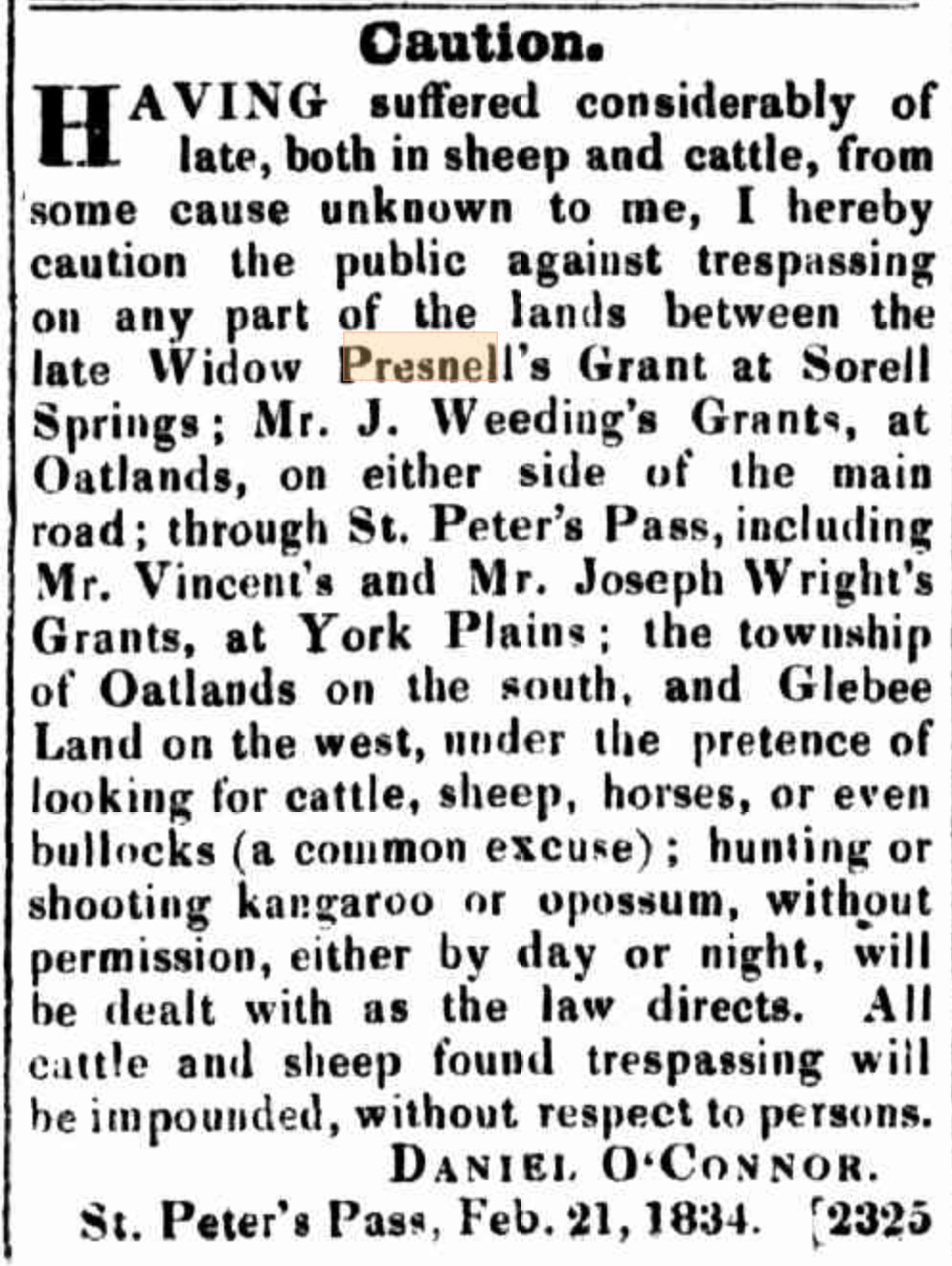
February 1834 · The late Widow Presnell
In a notice warning against trespass, Daniel O’Connor used the late Widow Presnell’s grant at Sorell Springs as a landmark. His wording places Eleanor’s death by 21 February 1834.
Spouse
Eleanor Skelton married John Presnell on 21 September 1807 at St Mary’s, Islington. They raised a family in London before sailing to Van Diemen’s Land aboard the Midas, arriving in Hobart in January 1821. John, a blacksmith by trade, became an innkeeper in the Midlands. After he died on 20 May 1831, Eleanor carried on the White Hart Inn at Antill Ponds, and the licence was renewed in her name that September.
Children
|
Name |
Date of birth |
Place of birth |
Date of death |
|---|---|---|---|
|
1808 |
London, England |
1870 |
|
|
William Presnell |
1810 |
London, England |
died young |
|
John Presnell |
1814 |
London, England |
1888 |
|
Frederick Presnell |
1817 |
London, England |
died young |
|
Eleanor Elizabeth Presnell |
1819 |
London, England |
1891 |
|
William Presnell |
1826 |
Antill Ponds Tasmania |
1904 |
|
Frederick Presnell |
1828 |
Antill Ponds, Tasmania |
1906 |
- Birth and parentage. Eleanor’s birth year of about 1788 is an estimate based on the age of 46 recorded in the transcription of her Oatlands headstone. Her parents and birthplace have yet to be confirmed.
- Marriage and arrival. The St Mary’s, Islington, banns entry records three announcements, the last on 2 August 1807. The marriage entry gives 21 September 1807 as the wedding date. The Midas shipping notice establishes the ship’s arrival in Hobart in January 1821, while John’s 1826 memorial records his passage aboard it. The names of the family members who made the voyage still need to be checked against a passenger record. Hobart Town Gazette and Southern Reporter, 13 January 1821
- The children. Eleanor’s June 1831 petition says she was left with five young children. The Land Board’s November report refers to three sons and three daughters. The records may have counted different members of the family. The baptism entries for William in 1810 and Thomas in 1812 give two further leads. The earlier William’s fate is still unknown, and a second William appears in the family records
- The land application. The Land Board recommended 500 acres under the 1828 regulations. Lieutenant-Governor George Arthur refused the grant, and Eleanor’s renewed petition was refused on 30 January 1832. The correspondence places her appeal during the shift from free grants to auction sales. The refusal gives no explicit reason. Tasmanian Archives, CSO1/79/1760, pp. 154–165.
- Death. The Oatlands headstone transcription gives 3 February 1831, but Eleanor’s later petitions and licence notices place her alive after that date. A newspaper notice refers to the “late Widow Presnell” on 21 February 1834. If the day and month on the headstone were read correctly, 3 February 1834 is plausible. The profile uses by 21 February 1834, the date supported by the newspaper notice. “Caution,” The Tasmanian, 21 February 1834, p. 2