Black Snake & Granton
Derwent River · Presnell family · 1810s–1830s
On the northern bank of the Derwent, near present-day Granton, stood one of the most important places in my early Tasmanian family story. Here the Presnells farmed land, operated a ferry and ran the Half-way House—later known as the Black Snake Inn.
The records also leave us with a mystery. Several men named Thomas Presnell appear in the story, and working out exactly which Thomas was responsible for what has proved considerably more complicated than I expected.
William Presnell — The Beginning at Black Snake
William Presnell was the first member of my Presnell family to establish himself at Black Snake. A convict who had arrived in New South Wales in 1798, he later spent several years on Norfolk Island before moving to Van Diemen’s Land in 1808.
By 1819 William was occupying land at Black Snake on the northern side of the Derwent. The location was strategically important. Travellers heading north from Hobart had to cross the river, and Black Snake became a stopping point on the developing route towards Launceston.
The Presnell property would become associated with farming, accommodation, a public house and the ferry crossing between Black Snake and Green Point.
The Half-way House
By 1822 a Presnell was licensed to operate the Half-way House at Black Snake, as well as the ferry across the Derwent to Green Point.
This is where the story becomes complicated.
The surviving records refer to Thomas Presnell, but there were several men of that name in the extended family. Later records distinguish between Thomas Presnell, Thomas Presnell Junior and other members of the family associated with Black Snake.
The Half-way House subsequently became known as the Black Snake Inn, beginning a long association between the Presnell family and this important stopping place on the Derwent.
Three Thomases
Trying to identify exactly who was doing what at Black Snake is complicated by one rather inconvenient fact: there were several Thomas Presnells.
My direct ancestor Thomas Presnell Senior, brother of William Presnell, was certainly associated with Black Snake by the 1820s. His son, Thomas Presnell Junior, also appears in records connected with the district. William, meanwhile, had a son named Thomas Fowler Presnell, born on Norfolk Island in 1804.
Contemporary records make the problem even more intriguing. In 1822 a Thomas Presnell was licensed to operate both the Half-way House at Black Snake and the ferry to Green Point. Yet records from only a few years later distinguish between more than one Thomas Presnell.
An 1825 government list is particularly revealing. It contains separate entries for Thomas Presnell, another Thomas Presnell, and Thomas Presnell Junior.
So which Thomas held the 1822 licence?
Thomas Presnell Senior
There is strong evidence that Thomas Senior was at Black Snake by the middle of the decade. By 1826 he was operating the Black Snake Ferry and claiming an interest in Black Snake Farm.
This makes him a strong candidate for the Thomas Presnell named in the 1822 Half-way House and ferry licences—but it does not yet prove it.
The question is made more difficult by an old family-tree assumption that Thomas Senior arrived in Hobart aboard the Regalia on 30 December 1822. Contemporary reporting of that ship’s arrival, however, names “Mrs S. Presnell and family”, not Thomas Senior.
If Thomas Senior was already operating the Half-way House earlier in 1822, then the accepted arrival date is clearly wrong.
Thomas Presnell Junior
Thomas Junior provides a much firmer piece of evidence.
In a land application dated 12 May 1827, he specifically described himself as “Thomas Presnell Junior.” He stated that he had been born in Oxfordshire in about 1806, had arrived in the colony in 1823, was living at Black Snake and possessed capital of £700.
He was subsequently granted 500 acres and later in 1827 received a licence for the Black Snake Inn.
That document is particularly valuable because Thomas Junior was identifying himself, rather than leaving us to decide which Thomas a clerk meant.
Thomas Fowler Presnell
The third possibility is Thomas Fowler Presnell, William Presnell’s son. He was born on Norfolk Island on 17 November 1804 and came to Van Diemen’s Land with his family in 1808.
Some later accounts have identified William’s son Thomas as the Presnell operating the Half-way House at Black Snake in 1822. There is a problem with that interpretation: Thomas Fowler would have been only 17 years old for much of 1822.
That does not make his involvement impossible, but it makes the identification questionable—particularly when another adult Thomas Presnell was also associated with Black Snake and the ferry during this period.
Thomas Fowler died in Hobart in 1838, aged only 33.
A Family Crossroads
Whatever the final answer to the 1822 mystery, the broader picture is much clearer.
Black Snake was not simply somewhere the Presnells happened to live. For a period during the 1820s it was a centre of their lives: a farm, ferry crossing, Half-way House and inn operated by members of the family beside one of the colony’s developing transport routes.
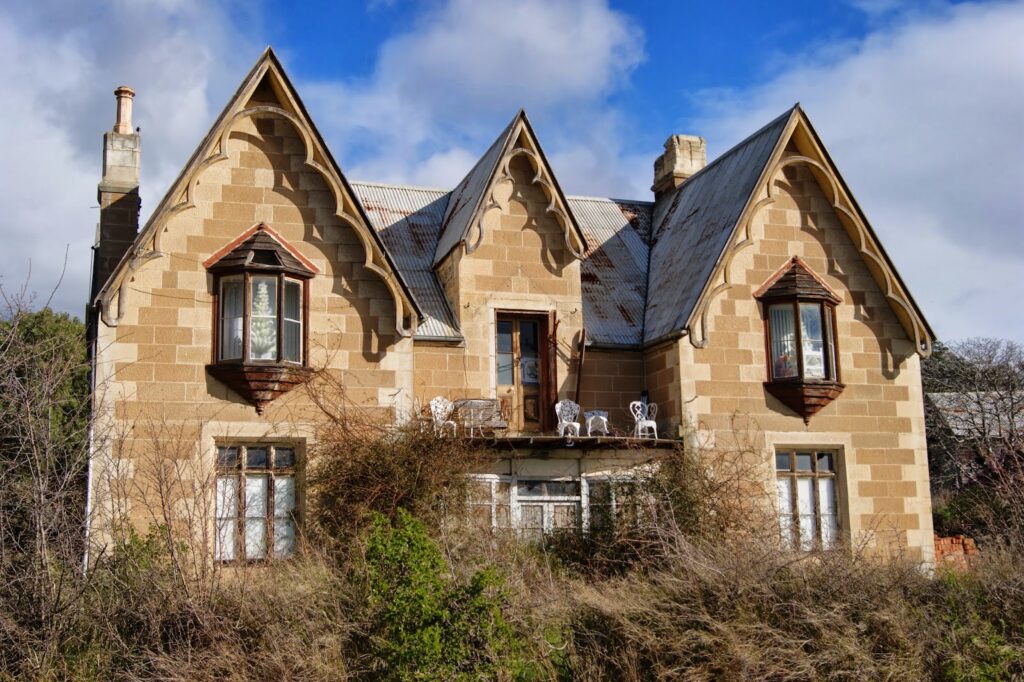
Nearly two centuries later, the building and the landscape provide a tangible connection with those first Presnell years in Van Diemen’s Land.