Thomas Reid
THE REID FAMILY · 1892–1916
From a Tasmanian farm to the battlefields of France
BORN
1892
Waratah, Tasmania
OCCUPATION
Farmer
26th Battalion, AIF
DIED
29 July 1916
France, aged 24
CHAPTER 01 · 1892–1915
Early Life in Tasmania
Thomas Reid was born around 1892 in Waratah, a mining town in north-west Tasmania. He was the son of William Reid and Annie Dallas, who are recorded as having married in Aberdeen, Scotland, on 21 December 1882. The family had settled in Tasmania by June 1887, when Thomas’s older sister, Margaret Annie Reid, was born in Launceston.
Thomas grew up in a family with strong connections to Tasmania’s north-west coast. His known siblings included Hugh Reid, Margaret Annie Reid and William Dallas Reid. By the time Thomas reached adulthood, he was working as a farmer, while his father, William Reid, was living in Burnie, according to Thomas’s military enlistment records.
Family records suggest that Thomas’s mother, Annie Dallas, died in 1911, although this has not yet been independently confirmed.
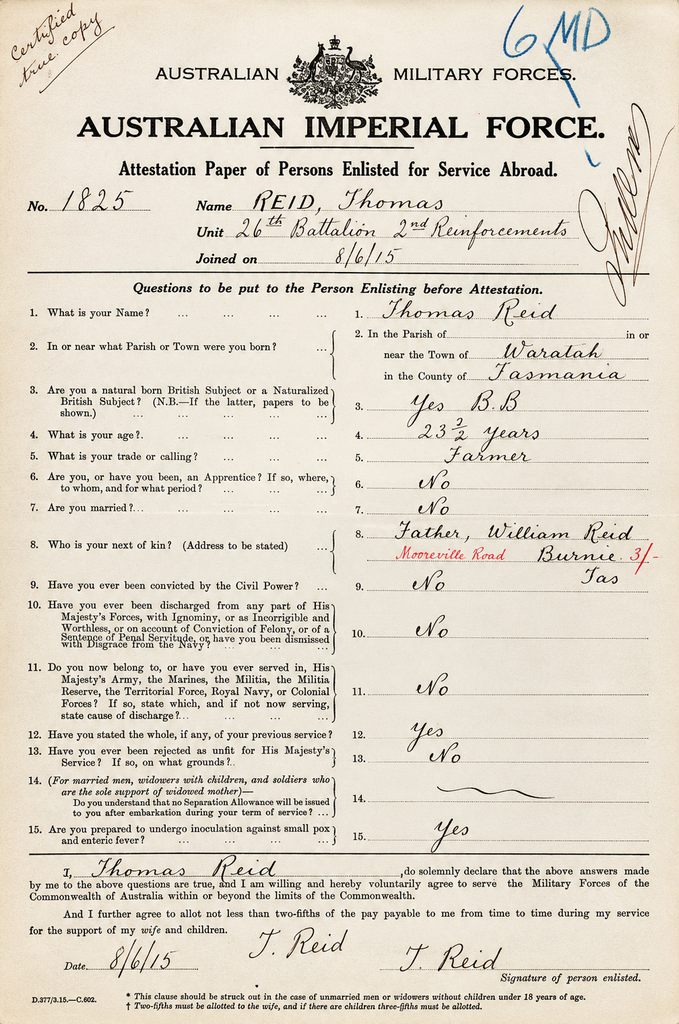
A Young Farmer Goes to War
In June 1915, Thomas Reid enlisted in the Australian Imperial Force at Claremont, Tasmania. Aged 23 and working as a farmer, he joined the 26th Battalion. His enlistment papers recorded his birthplace as Waratah and named his father, William Reid of Burnie, as his next of kin.
The surviving attestation papers also provide a rare physical description of Thomas, offering a glimpse of the young man who left Tasmania for military service.
Physical description recorded at enlistment
- Height: 5 feet 9½ inches (176.5 cm)
- Weight: 140 pounds (63.5 kg)
- Complexion: Fair
- Eyes: Grey
- Hair: Fair
- Religion: Methodist
CHAPTER 02 · 1915–1916
Service at Gallipoli
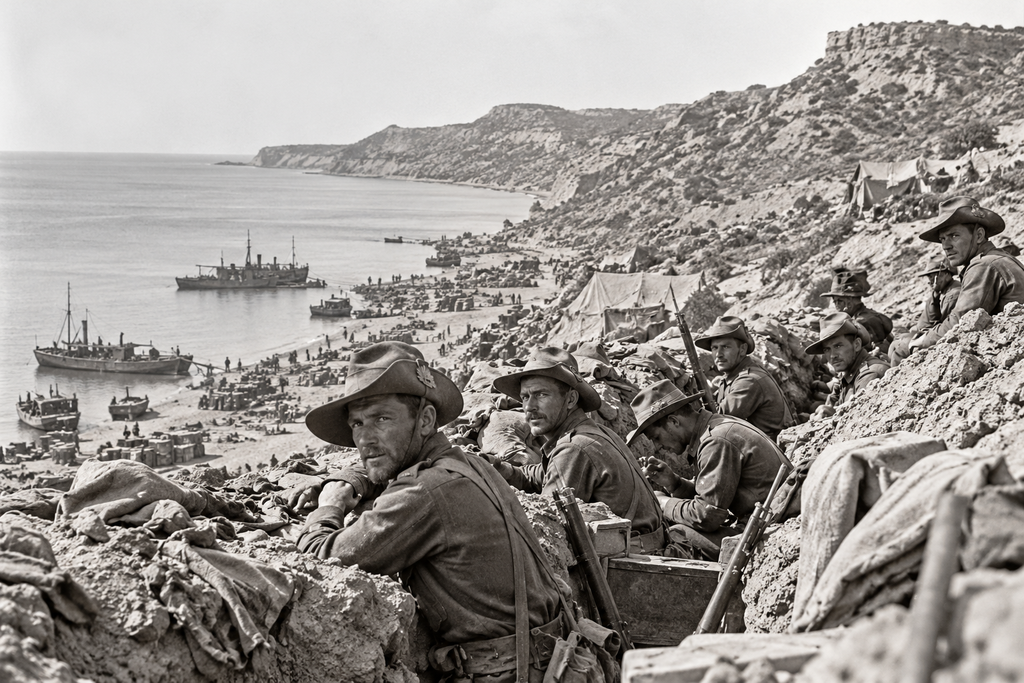
Anzac Cove, Gallipoli, 1915. Historical reconstruction depicting Australian soldiers overlooking the shoreline where Thomas Reid served with the 26th Battalion. Illustrative reconstruction, not an original photograph of Thomas or his unit.
Thomas travelled overseas in 1915 and joined the Australian forces serving in the Mediterranean. By October that year, he was serving at Anzac, Gallipoli, where the Australian troops faced difficult conditions, disease and persistent fighting. On 7 October, Thomas was admitted for medical treatment suffering from diarrhoea, but he subsequently recovered sufficiently to return to duty later that month.
Following the evacuation of Gallipoli, Thomas travelled to Egypt. His military service record documents his arrival at Alexandria from Mudros on 9 January 1916, marking the end of his service in the Gallipoli campaign and the beginning of the next stage of his wartime journey.
CHAPTER 03 · 1916
The Western Front
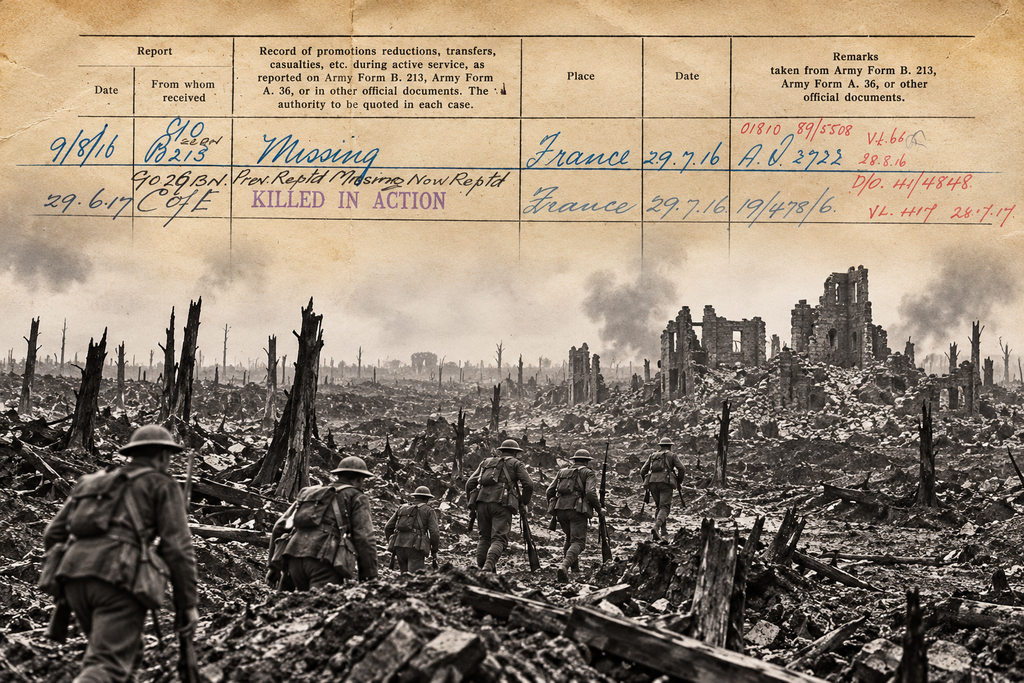
Historical reconstruction of the battlefield around Pozières, France, in 1916, incorporating Thomas Reid’s original military record documenting his disappearance on 29 July 1916 and subsequent confirmation of death.
In March 1916, Thomas Reid’s battalion moved from Egypt to France as Australian forces joined the fighting on the Western Front. His military service record documents his arrival at Marseilles on 21 March 1916. In early June, Thomas became ill with parotitis, associated with mumps, and received medical treatment before returning to his unit later that month. Within weeks, the 26th Battalion would be involved in the fierce fighting around Pozières on the Somme.
Missing in France — July 1916
On 29 July 1916, Thomas disappeared during fighting in France. Initially recorded as missing, his fate remained uncertain, leaving his family in Tasmania without confirmation of whether he was alive, wounded, captured or dead. The Australian military continued investigating his disappearance while his father, William Reid, waited for news in Burnie.
On 16 March 1917, the Base Records Office in Melbourne wrote to William concerning Thomas’s missing status and a correction to his battalion identification. The letter assured him that he would be notified if further information became available. By then, the Reid family had endured more than seven months of uncertainty.
Officially Declared Killed in Action
A Court of Enquiry held on 29 June 1917 determined that Private Thomas Reid had been killed in action in France on 29 July 1916, almost eleven months earlier. He was approximately 24 years old. His official death report identifies him as a member of C Company, 26th Battalion, Australian Imperial Force.
Although his death occurred during the period of fighting around Pozières, the surviving documents do not establish the exact circumstances of his final moments. For his family in Burnie, the official finding finally brought confirmation of a loss they had lived with for nearly a year.
Chapter 04 · 1917
His Personal Belongings Returned Home
On 24 August 1917, the Australian Imperial Force arranged to return Thomas Reid’s personal belongings to his father, William Reid, in Burnie. The possessions had been processed through the Australian Imperial Force Kit Store in London and transported aboard the Ayrshire. More than a year after Thomas’s death, these few items were finally making their way home.
ARCHIVAL RECORD · SEPTEMBER 1917
The belongings he left behind
- Cards
- One photograph
- One military book
- One brush
- Two handkerchiefs
On 4 September 1917, William Reid signed a receipt acknowledging that he had received the package.
The belongings were modest, but they offered a tangible connection to Thomas’s life. Among them was a photograph, its subject unknown, along with the everyday possessions he had carried during his military service. For William and the Reid family, these items were among the few personal reminders of the young man who would never return to Tasmania.
CHAPTER 05 · 1917-1923
Medals and Memorials
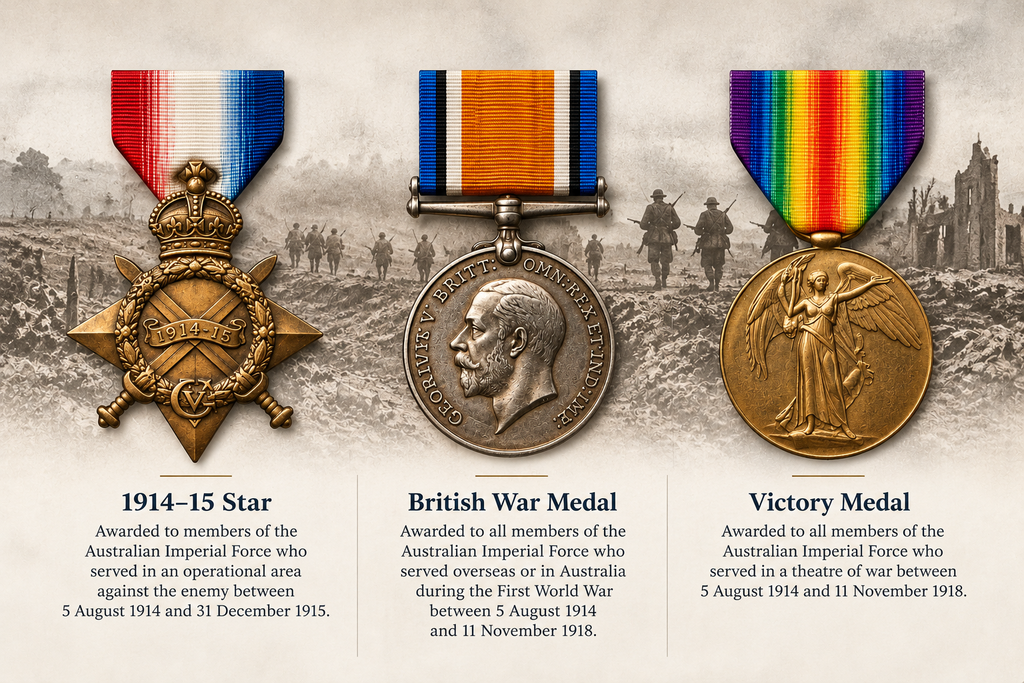
In recognition of his military service and sacrifice, Thomas Reid was awarded three First World War campaign medals: the 1914–15 Star, British War Medal and Victory Medal. His family also received a Memorial Plaque, Memorial Scroll and King’s Message commemorating his death.
On 2 October 1922, Thomas’s father, William Reid, signed receipts acknowledging the Memorial Plaque and Scroll. On 27 April 1923, almost seven years after Thomas’s death, William signed another receipt for his son’s Victory Medal. These surviving documents reveal how the official recognition of Thomas’s service continued long after the fighting had ended, and provide a moving record of a father receiving the memorials of his son’s sacrifice.
CHAPTER 06 · 1916–present
Remembrance
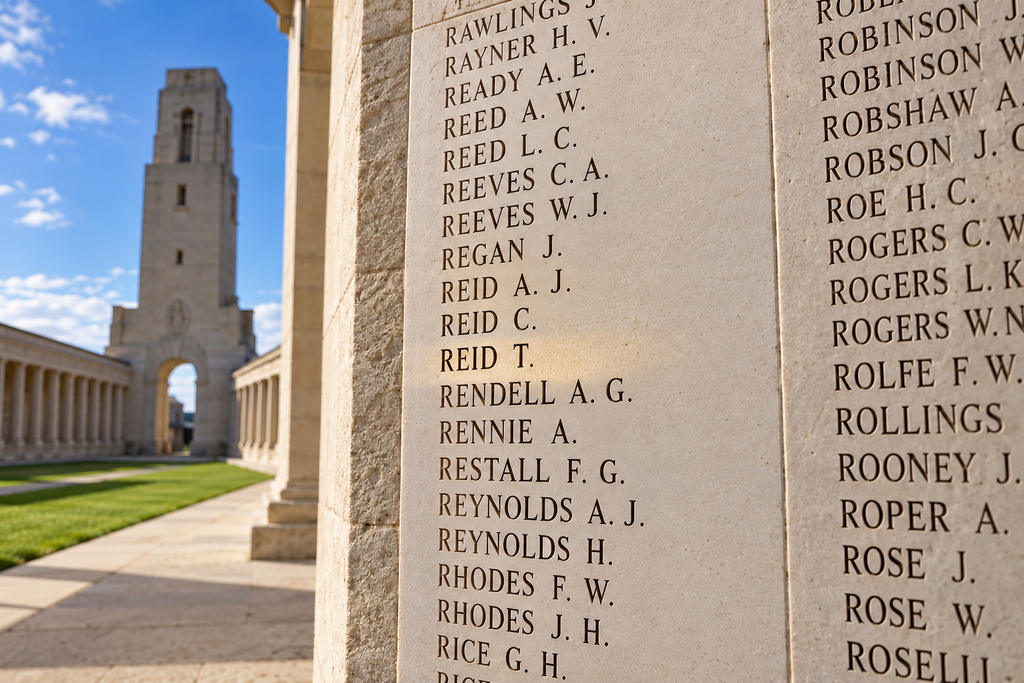
Remembered at Villers-Bretonneux
Thomas Reid has no known grave, but his name is commemorated at the Villers-Bretonneux Australian National Memorial, near Fouilloy in northern France. The memorial honours more than 10,700 Australian soldiers who died on the Western Front during the First World War and whose graves remain unknown. Their names are inscribed on its stone walls, ensuring their sacrifice is not forgotten.
Thomas is also remembered on the Roll of Honour at the Australian War Memorial in Canberra, where his name appears on Panel 108.
For William Reid and his family in Burnie, there was no grave to visit and no final resting place to mark their loss. Thomas’s personal belongings, returned in September 1917, and the medals and memorials received in subsequent years provided tangible reminders of the young farmer who had left Tasmania to serve his country.
More than a century later, Thomas Reid’s name remains among those commemorated in France, a permanent tribute to a life cut short far from home.
Remembering Thomas Reid
Thomas Reid’s life began in the mining community of Waratah, Tasmania, and ended on a battlefield in France, thousands of kilometres from home. He was just 24 years old when he died, leaving behind a family who waited almost a year for official confirmation of his fate.
His story survives through military records, correspondence, a handful of personal possessions and the memorials that bear his name. These documents tell us something of his service and sacrifice, but they also remind us of the young farmer, son and brother whose future was lost to war.
Thomas Reid was more than a name on a memorial. He was part of a family, part of Tasmania’s history, and part of our story.
- National Archives of Australia, Series B2455, Item 8027812, REID Thomas, First World War service dossier, 27 pages.
- Australian Imperial Force attestation papers, 8 June 1915.
- Army Form B.103, Casualty Form — Active Service.
- Army Form B.2090A, Report of Death of a Soldier, recording death on 29 July 1916.
- Australian Imperial Force Base Records correspondence, 16 March and 24 August 1917.
- Personal effects inventory and William Reid’s signed receipt, September 1917.
- Memorial Plaque and Memorial Scroll receipts, October 1922.
- Victory Medal receipt, 27 April 1923.
Thomas Reid’s Military Service Records
The surviving military records of Private Thomas Reid (1825), 26th Battalion, Australian Imperial Force, provide a remarkable account of his service, his death in France and the correspondence that followed between the Australian military authorities and his father, William Reid, in Burnie, Tasmania.
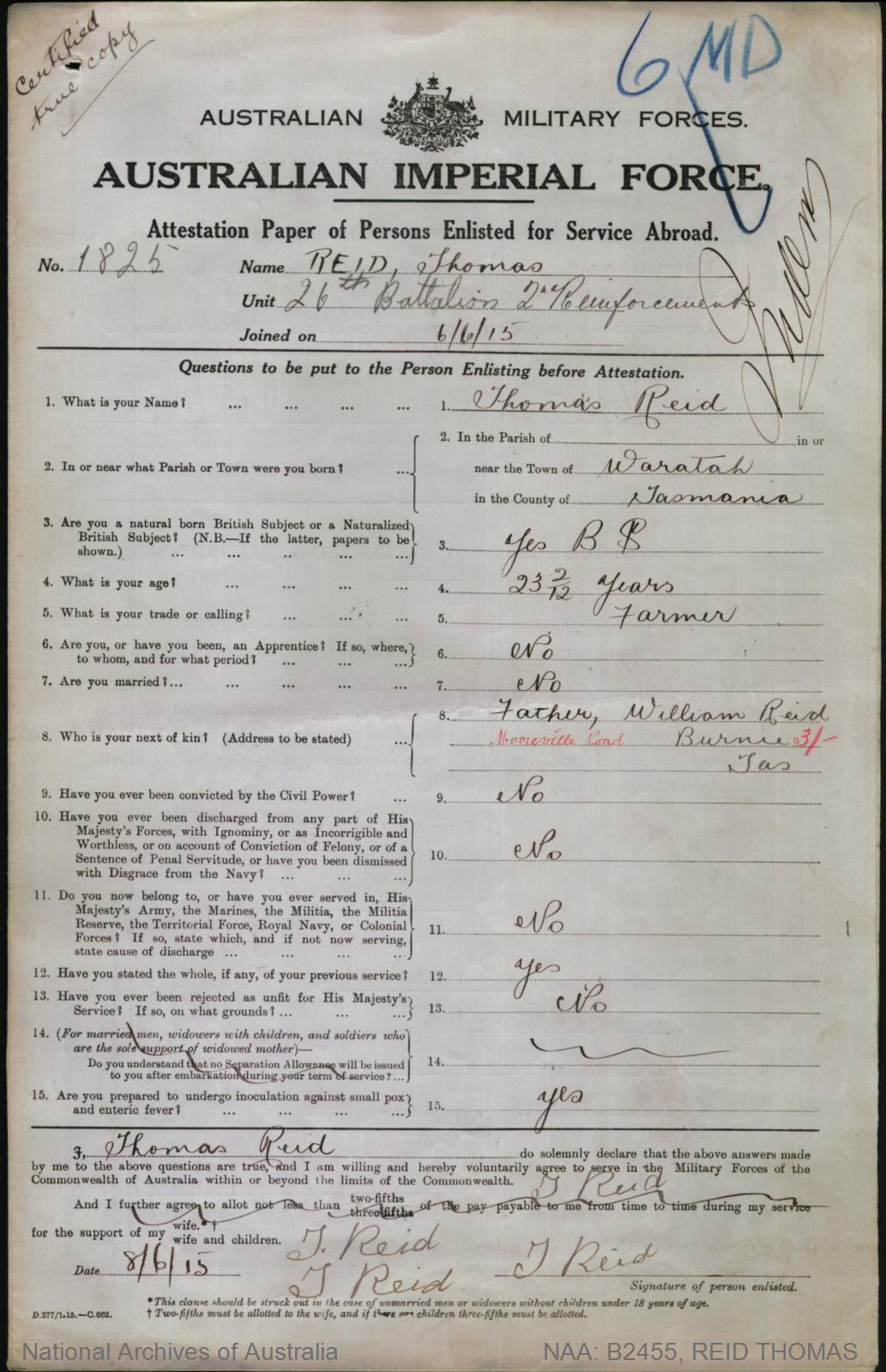
1. Enlistment Papers — 8 June 1915
Thomas enlisted at Claremont, Tasmania, aged 23. His attestation papers record his birthplace as Waratah, his occupation as farmer and his father, William Reid, as his next of kin.
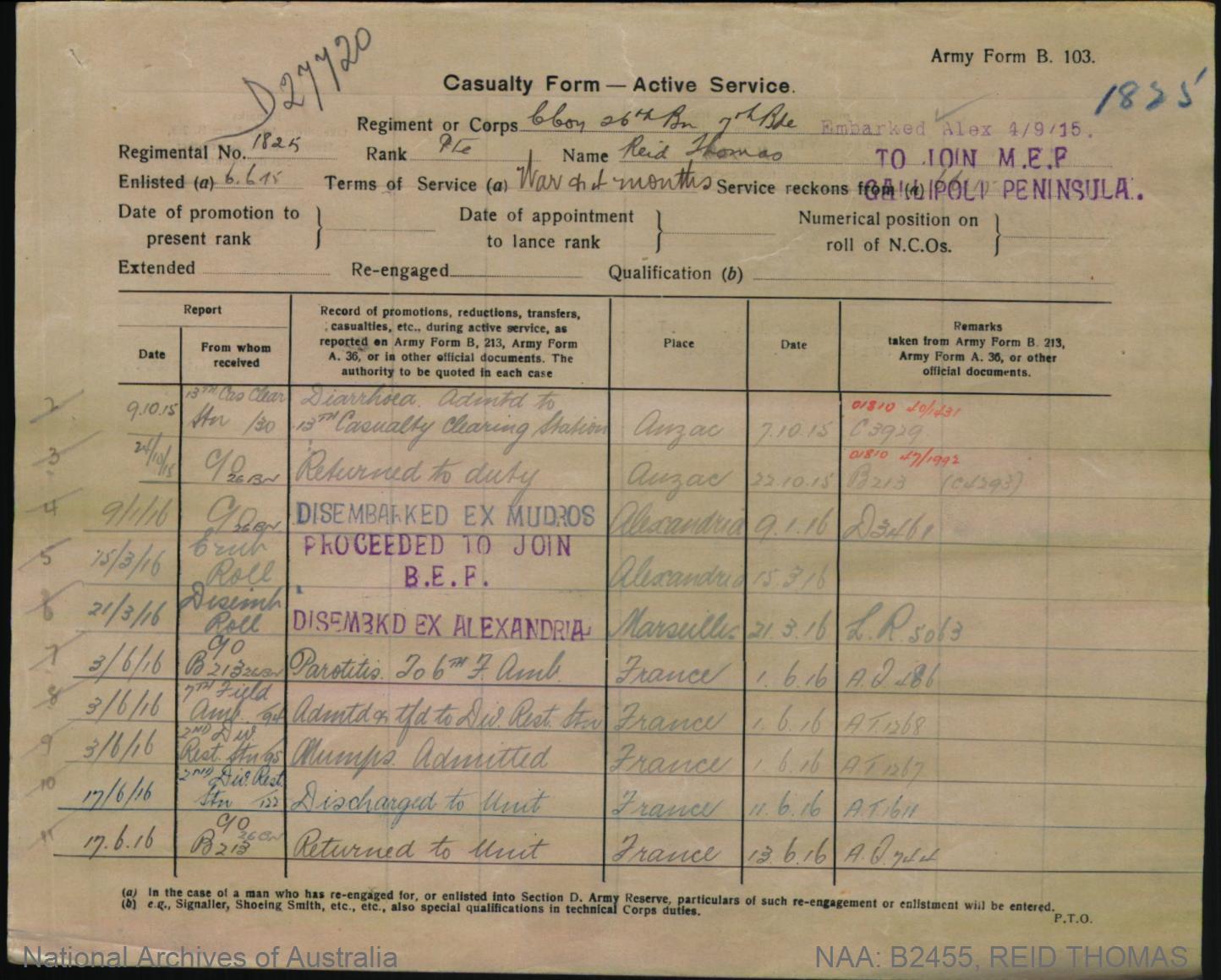
2. Military Service and Casualty Record — 1915–1917
His service records document his movements through Gallipoli, Egypt and France, including periods of illness and his disappearance during fighting on 29 July 1916.
A Court of Enquiry on 29 June 1917 subsequently determined that he had been killed in action.
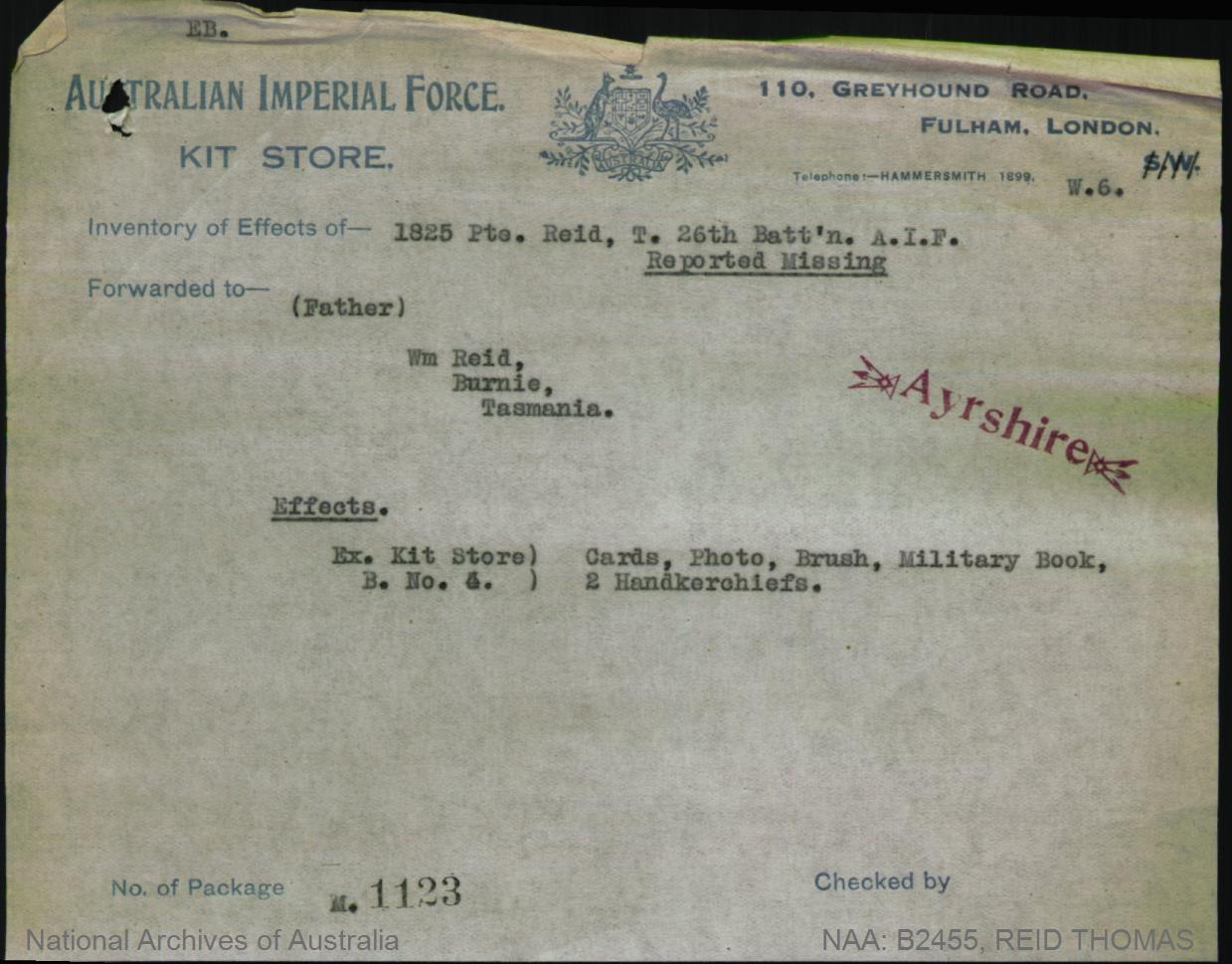
3. Personal Effects Inventory — 1917
The military recorded the personal belongings returned to Thomas’s father: cards, one photograph, a brush, a military book and two handkerchiefs.
William Reid signed for the package on 4 September 1917.
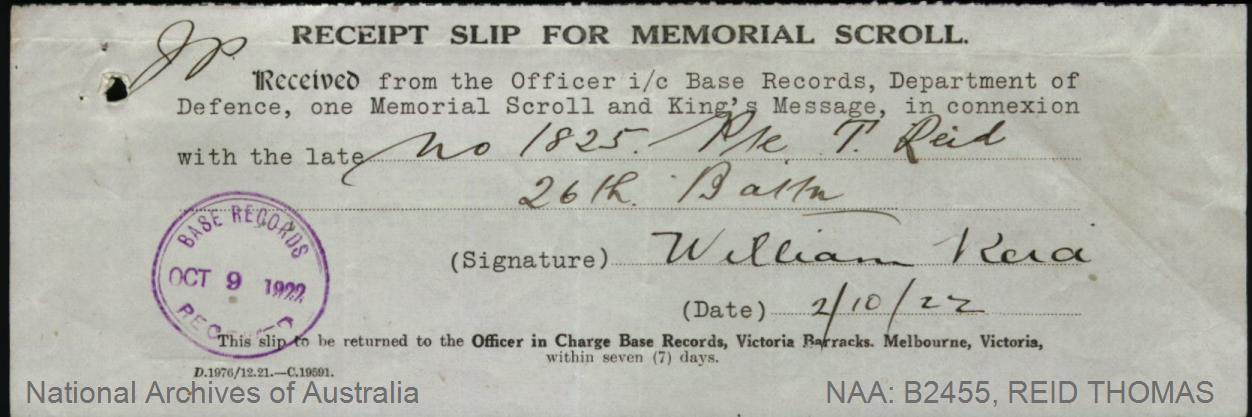
4. Memorial Plaque and Scroll Receipts — 2 October 1922
William Reid signed receipts acknowledging the memorial items issued in recognition of his son’s death.
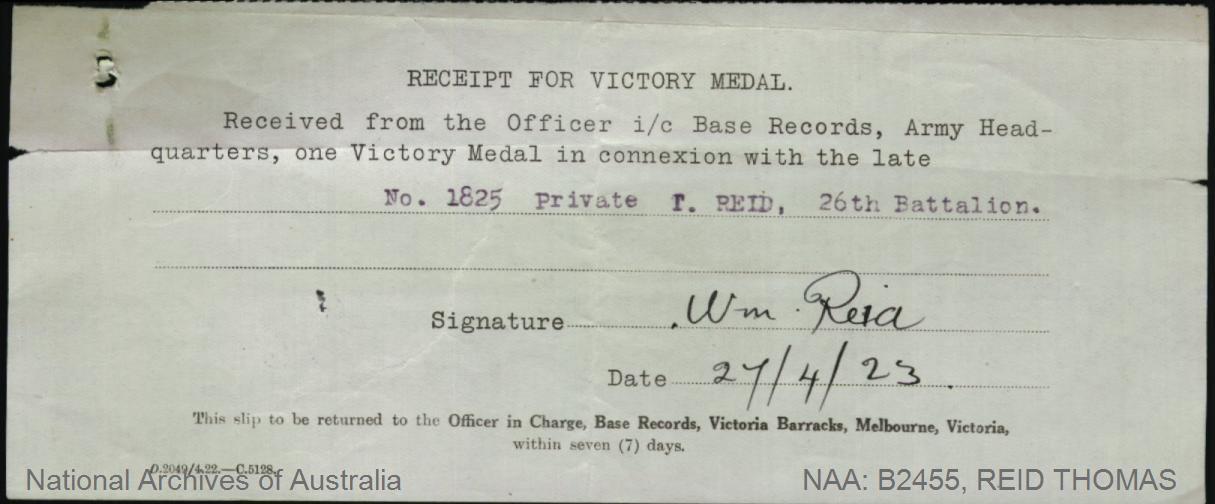
5. Victory Medal Receipt — 27 April 1923
William Reid’s signature on the receipt for Thomas’s Victory Medal provides important evidence that his father was still alive in April 1923.
Archival source: National Archives of Australia, Series B2455, Item 8027812, REID Thomas, First World War service dossier, 27 pages.
The Reid Family of Tasmania
Thomas Reid was born around 1892 at Waratah, Tasmania, into a family with roots in Aberdeen, Scotland.
His parents were William Reid and Annie Dallas, whose marriage is recorded as taking place in Aberdeen on 21 December 1882.
The family had established itself in Tasmania by June 1887, when Thomas’s older sister Margaret Annie Reid was born in Launceston.
Known Family Members
| Relationship | Name | Details |
|---|---|---|
| Father | William Reid | Living in Burnie during Thomas’s military service; signed military receipts as late as April 1923 |
| Mother | Annie Dallas | Reported to have died in 1911; confirmation still required |
| Brother | Hugh Reid | Born around 1885 in Aberdeen, Scotland |
| Sister | Margaret Annie Reid | Born 24 June 1887 in Launceston, Tasmania |
| Brother | William Dallas Reid | Further biographical details require verification |
Connection to the Presnell Family
Thomas’s sister Margaret Annie Reid married William George Presnell, connecting the Reid family to the Presnell family of north-west Tasmania.
Through this marriage, Thomas Reid forms part of the wider family history documented on Tasmania In My Blood.
Continuing Family Research
The surviving military records establish Thomas’s relationship with his father, William Reid, but several details of the wider family remain under investigation.
These include William Reid’s precise identity and date of death, the circumstances of Annie Dallas’s death, and the family’s movements between Scotland and Tasmania.
Research Notes — Thomas Reid (1892–1916)
The military service records provide substantial evidence of Thomas Reid’s life and death. However, several questions concerning his family remain unresolved.
1. The Identity of William Reid
Thomas’s father, William Reid, was living in Burnie during the First World War.
His signatures on military receipts dated 4 September 1917, 2 October 1922 and 27 April 1923 establish that he was alive at least until April 1923.
A possible match is William Alfred Reid, who died on 5 March 1924, aged 63, and was buried at Wivenhoe General Cemetery, Burnie.
A probate record for a farmer named William Reid of Mooreville Road records the same death date. Further evidence is required to establish whether this was Thomas’s father.
2. Annie Dallas and the 1924 Probate
Family records suggest that Thomas’s mother, Annie Dallas, died in 1911, but this has not yet been independently confirmed.
The 1924 probate identifies the deceased William Reid’s wife as Ann Reid, who was also named executor and beneficiary of his will.
If this probate belongs to Thomas’s father, the identity of Ann Reid requires investigation. She may have been a later wife, or the previously accepted death date for Annie Dallas may be incorrect.
3. Thomas’s Birth
Thomas’s military attestation papers identify Waratah, Tasmania, as his birthplace.
His recorded age indicates a birth around April or May 1892. A civil birth registration would help establish his exact date of birth and confirm his parents’ details.
4. Circumstances of His Death
Thomas was reported missing following fighting in France on 29 July 1916.
A Court of Enquiry held on 29 June 1917 subsequently determined that he had been killed in action on that date.
Although his death occurred during the fighting around Pozières, the precise circumstances have not been established from the surviving military documents.
5. Further Research
The principal outstanding tasks are:
- Locate Thomas Reid’s Tasmanian birth registration.
- Confirm Annie Dallas’s death date and place.
- Establish whether William Alfred Reid, who died in 1924, was Thomas’s father.
- Investigate the Reid family’s residence and property on Mooreville Road, Burnie.
- Verify the full list of Thomas’s siblings and their birth records.
Research status: Ongoing. Conclusions will be updated as additional original records become available.