Thomas Presnell Jr
1804–1880 · England to Van Diemen’s Land
MY FAMILY CONNECTION
3rd great-grandfather
Land, marriage and family life in early Van Diemen’s Land.
BORN
c.1804
England
MARRIED
11 July 1826
Christiana Presnell · New Norfolk
DIED
10 March 1880
Campbell Town, Tasmania
CHAPTER 01 · 1822–1826
A First Foothold in Van Diemen’s Land
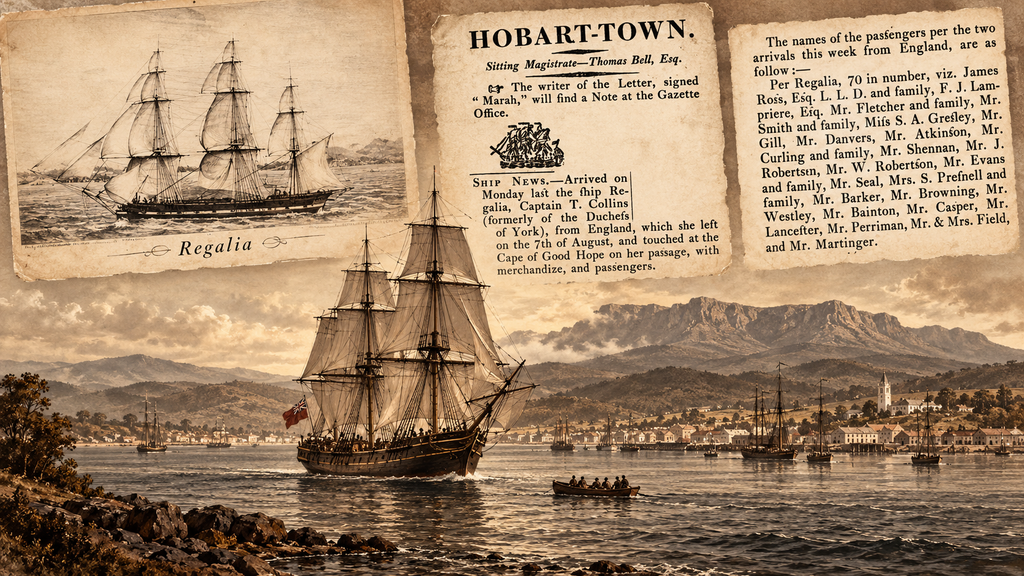
Illustrative reconstruction of the Regalia arriving in Hobart in December 1822. Thomas Presnell junior may have travelled with Sarah Presnell among the passengers described as “Mrs S. Presnell and family,” although his arrival aboard this vessel remains unconfirmed.
Thomas junior’s arrival in Van Diemen’s Land appears to have been part of a wider family migration. He may have accompanied his grandmother Sarah aboard the Regalia, which reached Hobart on 30 December 1822. The passenger notice names only “Mrs S. Presnell and family,” leaving his individual passage unconfirmed.
His early colonial life was closely connected with Thomas senior. On 30 June 1823, an 80-acre grant was recorded in Thomas junior’s name, adjoining land described as Presnell senior’s. The boundaries referred to Burrows’s Farm and a run called Little Swamp. The grant prohibited sale for five years and required eight acres to be cultivated within that period.
The neighbouring holdings suggest that Thomas junior began establishing himself with family nearby. Later records connect both men with the Half-way House at Black Snake, where their lives and livelihoods continued to overlap.
CHAPTER 02 · 1824–1826
Marriage to Christiana
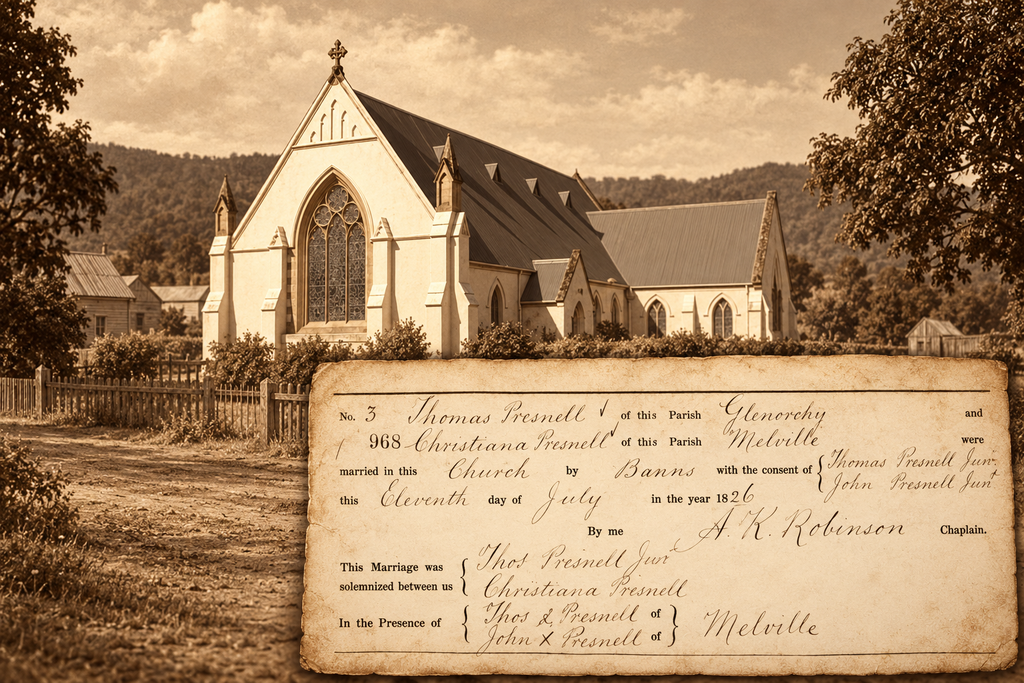
Thomas Presnell junior and Christiana Presnell married at St Matthew’s Church, New Norfolk, on 11 July 1826.
Thomas married Christiana Presnell at New Norfolk on 11 July 1826. The register describes him as being of the parish of Glenorchy and Christiana as being of Melville. They married in the church following the publication of banns.
The entry records the consent of Thomas Presnell senior and John Presnell senior. Thomas and John Presnell also appear as witnesses, both of Melville, with John making his mark. These names connect the couple with the wider Presnell family, although the register does not explicitly state their relationships.
Thomas and Christiana’s son John Thomas was born on 17 July 1824, almost two years before their marriage. He was baptised at New Norfolk on 17 September 1827.
CHAPTER 03 · 1826–1828
The Black Snake Inn
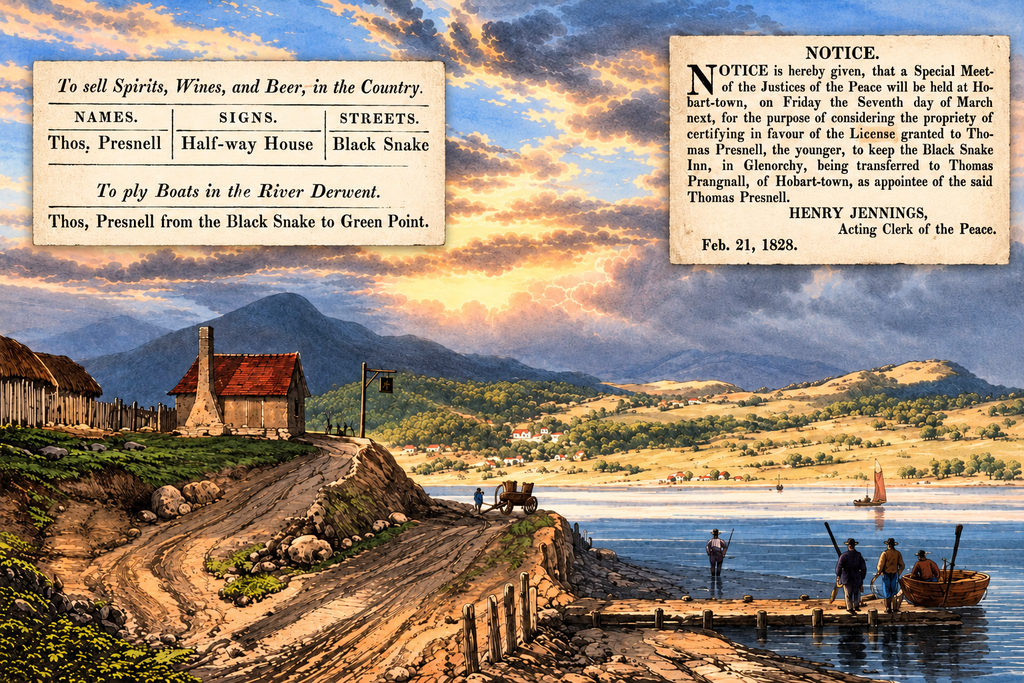
From his arrival in Tasmania until about 1828, Thomas junior likely lived in and around Black Snake, now Granton.
By April 1826, Thomas Presnell junior was established at Black Snake, now Granton. An advertisement seeking the return of a missing black-and-white sow referred to “my premises at the Black Snake.” That September, Thomas senior publicly asserted ownership of the Half-way House and its 50-acre farm, describing the property as being in Thomas junior’s possession.
Thomas and Christiana remained in the district after their marriage. When their son John Thomas was baptised in September 1827, the register recorded their abode as Black Snake and Thomas’s occupation as publican, directly connecting the family with the local hospitality trade.
In February 1828, the Hobart Town Courier announced a proposed transfer of the Black Snake Inn licence from Thomas Presnell “the younger” to Thomas Prangnall. By 15 March, Prangnall advertised that the transfer had been obtained. This marked the end of Thomas’s tenure as licensee and may also have been when the family moved away from Black Snake.
CHAPTER 04 · 1834
Tragedy at Antill’s Ponds
hree-year-old Eleanor Amelia Presnell died from burns at Antill’s Ponds. An inquest into her death was held on 25 April 1834.
Image suggestion: the Antill’s Ponds landscape or Half-way House ruins, with the newspaper report inset.
Caption: T
By April 1834, the family’s story was connected with Antill’s Ponds in Tasmania’s Midlands. The True Colonist reported that Eleanor Amelia, the three-year-old daughter of Mr Thomas Presnell, had been burned to death there.
Coroner Thomas Anstey held an inquest on 25 April. The brief newspaper report records the tragedy but gives no account of how the fire began or the circumstances surrounding Eleanor’s death.