
The View From My Beer
It’s taken a while, but I finally found a British lager on tap at the Trafalgar Tavern in East Greenwich. I enjoyed a pint of Brixton Lager next to the Thames.
Greenwich
While I had travelled to London many times over the years, I had never made my way to Greenwich. Having just completed two months cruising Northern Europe, I had a one-day stay in London before heading back to Australia via Singapore. Just enough time for me to catch a train from Southampton to spend the afternoon in Greenwich, before my evening flight to Singapore.
Greenwich is famous for being the place through which the Prime Meridian (0° longitude) and from which Greenwich Mean Time (GMT) was established at the Royal Observatory. It has a rich maritime history with sites like the Old Royal Naval College and National Maritime Museum. It also has royal connections, being the birthplace of Henry VIII and Elizabeth I at the former Palace of Placentia. It’s also a UNESCO World Heritage site and a historic hub for astronomy, naval architecture, and even the filming location for parts of the movie Four Weddings and a Funeral.
My Walk

After disembarking Princess Emerald early in the morning, I took the bus to Heathrow, so I could store my bags for the day. Now I only had a backpack to look after, allowing me the necessary freedom to take a tube train to Greenwich and walk around for a few hours. Not a lot of planning went into today’s itinerary, I knew there was the Prime Meridian and a Naval Observatory and I was bound to find a pub – Perfect!
O2 Arena


The train took me to North Greenwich. from there I could see the O2 Arena. It looked interesting from a distance, but I didn’t know much about this area at all. The O2 arena is for shows, but is is completely encircled by an up market shopping centre. This included a VR roller coaster. Outside that is another entertainment district with lots of modern buildings and interesting things.
Maritime Museum

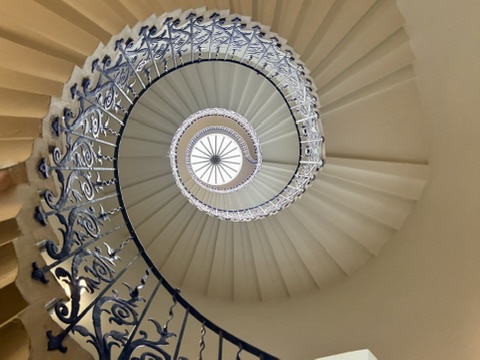


Greenwich has a collection of historical buildings. Queen’s House (left) is one of the most important buildings in British architectural history, being the first consciously classical building to have been constructed in the country. It iwas a royal residence built between 1616 and 1635. It presently serves as a public art gallery, with free admission. Inside, the tulip stairs provided an awesome photo opportunity.
The National Maritime Museum was free to enter and contained a lot of artifacts from the era in which England used its naval superiority to colonize much of the New World, including Australia.
The Royal Observatory was commissioned in 1675 by King Charles II, and played a major role in Astronomy. It was here that the concepts of Greenwich Mean Time (GMT) and the Prime Meridian, which passes through the observatory, was established. Traditionally, a red ‘time ball’ at the top of the building is dropped at exactly 1PM each day. This used to allow ships in the area to adjust their own watches and clocks.
Prime Meridian


The Prime Meridian was not quite as spectucular as I imagined. There was a plaque on a wall that officially designated the spot through which it crossed. Nearby in Greenwich Park was a sundial that i could image was used to establish its location, the Prime Merdian being the spot on which the sun is directly overhead at noon on the days of the two equinoxes. The Prime Meridian also formed a line that dissected the University of Greenwich (left) and Royal Naval College (right).
Greenwich Village


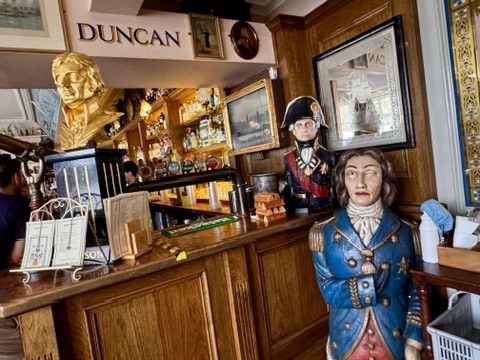


After a pleasant walk along the banks of the Thames river, passing the Cutty Sark, I found my way to Greenwich Village and the Greenwich Market. This is where I found the colorful Georgian pub, the Trafalgar Tavern.

One of the more unusual sights today, was a statue with a dead parrot. As soon as I saw it I was pretty sure it was a reference to the well-known Monty Python sketch – This Parrot is Dead. And indeed it was. The sculpture was located in the Devonport House hotel by artist John Reardon in 2009. For Month Python fans out there you might notice this one looks like a sulphur-crested cockatoo and not a ‘Norwegian Blue’ as used in the original Monty Python sketch.
